


 TANSI Weekly Forum
26
June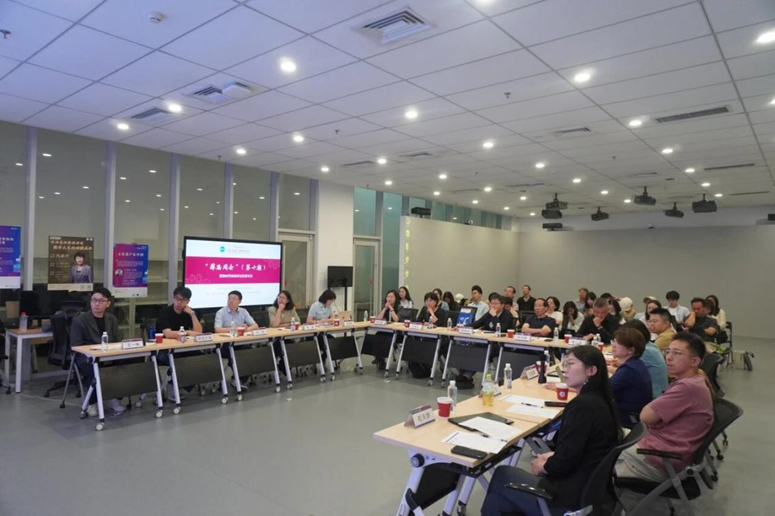
The tenth TANSI Weekly Forum and the seventeenth Digital Humanities (DH) Boundless Forum on Urban Memory in the Digital Intelligence Era was successfully held on the afternoon of June 10, 2026. The event was hosted by the National Academy of Development and Strategy, Renmin University of China, and co-organized by Research Center for Digital Humanities and School of Information Resource Management of Renmin University of China.
Professor FENG Huiling, National First-Class Professor, Former Executive Vice President of Renmin University of China, and Director of Research Center for Digital Humanities, delivered the opening address. The conference specially invited LIU Yuzhu, Chairman of the China Foundation for Cultural Heritage Conservation; TANG Keyang, Principal Researcher of the Future Laboratory at Tsinghua University; and XIA Cuijuan, Professor at the School of Information Resource Management and Research Fellow of Research Center for Digital Humanities, Renmin University of China, to deliver keynote speeches. ZHANG Juan, Deputy Librarian and Research Librarian of the Capital Library of China; WANG Haiyan, Deputy Director and Research Archivist of the Beijing Municipal Archives; SONG Yangyang, Vice Dean of the Institute of Creative Industry Technology, Renmin University of China; and QI Tianjiao, Associate Professor and Head of the Archives Department at the School of Information Resource Management, Renmin University of China, participated in thematic discussions. At the event, WANG Yinan, Research Fellow at Research Center for Digital Humanities, unveiled the research outcomes of the four-dimensional virtual reconstruction project of Beijing (四维北京). LANG Jiaziyu, the third-generation inheritor of Lang’s Beijing Dough Figurines, a national-level intangible cultural heritage, and SONG Zhuangzhuang, Co-founder of DDH Studio, delivered special speeches. LIN Shangli, Former President of Renmin University of China, Dean of the National Academy of Development and Strategy, and Professor at the School of International Relations, delivered concluding remarks. XIAN Wangjuan, Deputy Secretary-General of the China Foundation for Cultural Heritage Conservation; DENG Yao and SUN Yi, Senior Researchers at Tencent Research Institute; as well as experts, scholars, faculty and student representatives from relevant fields both inside and outside the university attended the activity.
Prior to the seminar, the invited guests and faculty-student representatives visited the laboratories of Research Center for Digital Humanities and viewed on-site exhibitions showcasing the institute’s research achievements.
The seminar was co-hosted by LIU Yuenan, Professor and Dean of the School of Information Resource Management as well as Vice Director of Research Center for Digital Humanities, Renmin University of China, and WANG Wei, Vice Dean of the National Academy of Development and Strategy, Renmin University of China. The TANSI Weekly Forum ushered in its 10th session on this occasion. At this special milestone, the hosts delivered a brief review and comprehensive summary of the meeting's strategic positioning and the outcomes achieved since its inception. The TANSI Weekly Forum is a branded interdisciplinary forum focusing on cutting-edge research topics, elaborately developed by the National Academy of Development and Strategy at Renmin University of China. Since its launch, the seminar has consistently centered on frontier academic and policy issues. It pools intellectual strengths from all university innovation hubs and schools, together with distinguished academic and policy experts from home and abroad, to conduct in-depth exchanges and discussions. The forum has facilitated the production of high-quality think tank outputs characterized by strategic vision, acute insight into contemporary trends and profound theoretical depth. It continuously advances innovation in knowledge, theory and policy, and fosters a mutually reinforcing dynamic where academic disciplines underpin policy consultation and think tank research nourishes disciplinary development in return.
Professor FENG Huiling delivered the opening address. She stated that the TANSI Weekly Forum aims to stimulate intellectual exchange through in-depth and extensive deliberation, while the DH Boundless Forum highlights breaking down boundaries between disciplines, campuses, and China and the rest of the world. This session centers on Urban Memory in the Digital Intelligence Era owing to cities’ pivotal role in the evolution of human civilization, as well as the risks of fragmentation and loss confronting urban memory amid the digital age. She expressed her expectation that participating experts would explore effective approaches for digital technologies to empower urban memory through dialogue.
WANG Yinan presented the outcomes of the Four-Dimensional Beijing urban virtual reconstruction project. He introduced that the project was launched in 2018 and innovatively constructed a four-dimensional urban model integrating historical time and three-dimensional space. For the first time, historical events were embedded into urban spatial narratives. So far, urban modeling covering more than 130 square kilometers of Beijing across major historical eras from the Western Zhou Dynasty to the Republic of China has been completed. The project leads similar initiatives in terms of geographic coverage, time span and richness of cultural elements.
Chairman LIU Yuzhu delivered a keynote speech titled “Practice and Prospects of the Protection, Inheritance and Utilization of Cultural Heritage in the New Era”. He pointed out that against the backdrop of the 15th Five-Year Plan Outline which lays out clear arrangements for the protection, inheritance and utilization of cultural heritage, digital and intelligent technologies are profoundly transforming the modes of cultural heritage conservation and communication. He stressed that we should improve the systematic conservation system based on the newly revised Cultural Relics Protection Law of the People’s Republic of China. Digital technologies shall be leveraged to make cultural relic resources accessible to the general public and realize the living inheritance of cultural heritage. The protection and utilization of cultural heritage should be organically integrated into national strategies including rural revitalization and urban renewal, so as to build an open ecosystem featuring government leadership, public participation and coordinated international cooperation. Drawing on cases such as the “Virtual Tour of the Great Wall” and the “Digital Central Axis”, he illustrated innovative practices where digital and intelligent technologies empower the conservation and dissemination of cultural heritage.
Researcher TANG Keyang delivered a keynote speech titled “Invitation and Encounter of the City: A Brief Discussion on Spatial Intelligence”. Taking “date” and “encounter” as the starting point, he explored cognitive processes within urban spaces in the digital age. He pointed out that spatial intelligence concerns not only the perception of physical space, but also cognitive transition spanning “experience-logic-narrative”, as well as the mutual transformation among imagery, structure and meaning. Drawing on Kevin Lynch’s theory of the Image of the City, he analyzed how urban spaces shape people’s understanding and memory of cities through elements such as paths, nodes and landmarks. He proposed that we should re-examine the value of cities as cognitive media and cultural carriers from the interactive relationship between space and human beings.
Professor XIA Cuijuan delivered a keynote speech titled “Digital Presence: The Construction and Representation of Urban Memory in the Digital Intelligence Era”. Inspired by Martin Heidegger’s theory of “presence”, and drawing on classic theories and core motifs in memory studies, such as the interdependent relationship between memory and forgetting, and the persistent tension between memory and history, she proposed that “digital presence” constitutes a new paradigm for memory research in the digital intelligence age. She argued that unlike physical presence, digital presence enables in-depth engagement and multi-sensory experience via digital media. It bridges history and reality, assembles fragmented memories, and opens up new possibilities for the canonization, embodied practice, continuity of traditions and cultural inheritance of digital memory. With practical cases of urban memory projects, she illustrated innovative applications of digital presence in the construction and representation of urban memory through spatial restoration, scene reconstruction, time folding, synchronic presentation of historical events and other forms.
Following the keynote speeches, participating experts engaged in in-depth exchanges centered on the conference theme.
Drawing on the practical experience of the “Beijing Memory” project at the Capital Library of China, Deputy Librarian ZHANG Juan introduced the progress in constructing a public fundamental corpus of Beijing’s history and culture. She pointed out that the “Beijing Memory” initiatives carried out respectively by the Capital Library and Renmin University of China represent two distinct approaches to the construction of urban memory. The former prioritizes resource preservation and the development of data infrastructure, while the latter focuses on knowledge production and creative interpretation. She expressed the hope that the two sides would deepen cooperation in the future to jointly advance the exploitation, utilization and dissemination of Beijing’s historical and cultural resources.
Deputy Director WANG Haiyan shared the practical work of Beijing Municipal Archives and elaborated on the vital role of archival resources in preserving urban memory and carrying forward historical cultural veins. She stated that archives serve as a crucial carrier of a city’s historical trajectory and collective memory, as well as an essential foundation for constructing urban memory. Taking the development and utilization of collected Peking Opera script archives as an example, she proposed strengthening collaborative partnerships among archives, relevant cultural institutions and digital humanities research platforms to explore digital preservation and innovative communication of urban cultural memory.
Vice Dean SONG Yangyang delivered remarks from the perspective of technology integration and cultural industry development. He put forward that urban memory is not merely a type of cultural resource, but also the cultural infrastructure and innovative production factor for urban development. Through resource activation, scene creation and institutional innovation, urban memory should be integrated into public cultural services, research and study education, as well as cultural tourism consumption scenarios, so as to transform historical resources into public value and driving forces for development.
Associate Professor QI Tianjiao discussed the relationship between archives and urban memory from an archival science perspective. She pointed out that the construction of urban memory relies not only on existing archival resources but also on new archival appraisal and collection methods to preserve more fragments of urban memory. Drawing on the practical experience of the “Beijing Memory” project, she introduced thematic archives such as “Voices of Beijing”. She emphasized that archival methodologies can underpin the collection, organization and preservation of urban memory, while urban memory projects in turn open up new avenues for the digital transformation of archival science.
During the special speech session, LANG Jiaziyu, inheritor of Lang’s Beijing Dough Figurines, a national-level intangible cultural heritage, shared his explorations in the digital recording, communication and revitalization of traditional craftsmanship based on his intangible heritage inheritance practice. SONG Zhuangzhuang, Co-founder of DDH Studio, took the “Beijing Cultural Relics Map” project as an example to illustrate the practice of building an open urban knowledge base through public co-creation. He advocated leveraging digital technologies to boost the open sharing of cultural heritage data and public participation, and to pioneer new approaches for the preservation and dissemination of urban memory.
Professor LIN Shangli delivered the concluding comments. He pointed out that the digital intelligence era has profoundly transformed human cognitive patterns and memory mechanisms. The construction of urban memory must respond to such shifts while upholding respect for historical authenticity and memory itself, avoiding the simplistic equation of memory with mere experience. Focusing on the core issues of urban memory in the digital age, he proposed that reflections should be carried out on three dimensions: the memory of urban spaces as living entities, people’s recollections of urban history, and memory systems built upon digital carriers. He also called for further attention to functions including archival digitization, digital conservation and digital restoration. He stressed that the development of urban memory requires solid academic foundations and theoretical underpinnings. Meanwhile, it is necessary to take into account diverse dimensions such as presentation forms, thematic orientations, implementation pathways, technologies, target audiences and market demands, so as to translate urban memory resources into public value, cultural products and drivers of urban development.
This symposium has established a high-standard academic exchange platform spanning multiple disciplines, institutions and sectors. It brought together specialists from cultural heritage conservation, digital humanities, archival studies, public cultural services, creative industries, intangible cultural heritage inheritance and other relevant fields, who engaged in in-depth discussions concerning the conservation, construction, representation and utilization of urban memory amid the digital intelligence era. The event facilitated mutual learning between theoretical research and practical innovation, offering fresh perspectives and inspiration for advancing the digital conservation, innovative communication and revitalized utilization of urban memory.
Reviewers: WANG Wei, FENG Huiling
Executive Editors: LIU Qi, YANG Fanxin, ZHANG Jingjing
Translator: ZHANG Yuqing
Web Editor: ZHANG Jingjing
Introduction to the Innovation Hub
Research Center for Digital Humanities of Renmin University of China is a university-level interdisciplinary research institute founded by Renmin University of China in 2022. Its predecessor was affiliated with the School of Information Resource Management, established in 2021. It ranks among the first batch of innovation hubs built by the university, and its academic lineage can be traced back to the pioneering research on “Digital Memory” launched in 2013. Focusing on cutting-edge fields including digital memory, urban digital reconstruction, digital historiography and digital Confucian classics studies, the Institute devotes itself to in-depth theoretical research, project practice, talent cultivation and academic exchanges in digital humanities.
About TANSI Weekly Forum
The “TANSI Weekly Forum” is a high-level interdisciplinary discussion platform established by the National Academy of Development and Strategy at Renmin University of China. Focusing on frontier academic and policy issues, the forum brings together the intellectual strengths of the university’s innovation hubs as well as leading scholars and policy experts across sectors. Through in-depth exchanges and discussions, the forum aims to produce high-quality think tank achievements characterized by strategic vision, contemporary relevance, and intellectual depth. It serves as an important platform for advancing knowledge innovation, theoretical innovation, and policy innovation, while promoting the mutually reinforcing relationships between academic disciplines, policy consultation, and think tank development.