


 Research Update
04
June
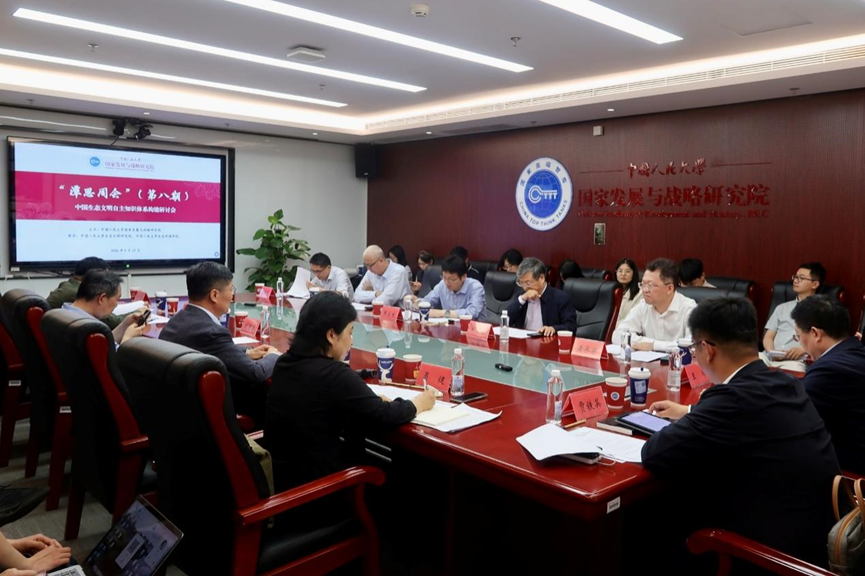
On the 10th anniversary of President Xi Jinping’s important speech at the Symposium on Philosophy and Social Sciences, the Eighth TANSI Weekly Forum, themed “Seminar on the Construction of an Independent Knowledge System for China’s Ecological Civilization,” was successfully held on May 15, 2026. The event was hosted by the National Academy of Development and Strategy and co-organized by the Institute of Ecological Civilization and the School of Ecology and Environment at Renmin University of China.
The seminar invited ZHANG Yongsheng, Director and Senior Research Fellow of the Research Institute for Eco-civilization, Chinese Academy of Social Sciences (CASS), and HUAN Qingzhi, Director of the Research Center for Xi Jinping Thought on Ecological Civilization and Professor at the School of Marxism, Peking University, to deliver keynote speeches. Participating scholars and experts included YU Hai, Deputy Director and Senior Research Fellow of the Research Center for Xi Jinping Thought on Ecological Civilization; LIU Shouying, Professor at the School of Economics, Renmin University of China; ZHANG Yunfei, Professor at the School of Marxism, Renmin University of China; HUANG Chengliang, Secretary-General and Senior Research Fellow of the Research Center for Xi Jinping Thought on Ecological Civilization at CASS; ZHU Chunquan, former Chief Representative for Greater China of the World Economic Forum Nature Initiative, former Country Representative to China of the International Union for Conservation of Nature, and Research Fellow at the Chinese Academy of Forestry. Professor WU Jian, Executive Dean of the Institute of Ecological Civilization, Renmin University of China, chaired the seminar and delivered concluding remarks. JIA Tieying, Secretary of the Party Committee of the School of Ecology and Environment, Renmin University of China, and WANG Wei, Vice Dean of the National Academy of Development and Strategy, Renmin University of China, also attended the seminar.
Representatives of faculty and students from universities including Peking University, Tsinghua University, Renmin University of China, Beihang University, and Beijing Normal University, as well as experts and scholars from institutions such as the Macroeconomic Research Institute of the National Development and Reform Commission, participated in the seminar.
ZHU Xinkai, Member of the Standing Committee of the Party Committee, Executive Vice President of Renmin University of China, and Dean of the Institute of Ecological Civilization, sent a written address. He emphasized that universities and other key institutions in philosophy and social sciences serve as the primary force in building an independent knowledge system of philosophy and social sciences with Chinese characteristics. Through initiatives such as the University Alliance for Building China’s Independent Knowledge System and innovative platforms including the Institute of Ecological Civilization, Renmin University of China has actively promoted the development of China’s independent knowledge system in this field. He proposed taking this seminar as a new starting point to further pool academic wisdom, produce landmark research achievements, and enhance academic influence, policy support capacity, and social impact.
Beginning with the implied meaning of “TANSI”, Professor WU Jian explained the original purpose of the seminar and introduced its central theme: how to move beyond dependence on Western ecological discourse and establish China’s independent knowledge system for ecological civilization. Discussions focused on major issues including research objects, conceptual categories, theoretical frameworks, and methodological innovation. Professor Wu noted that the seminar brought together experts and scholars from government departments, research institutions, universities, and media organizations to foster interdisciplinary dialogue, build intellectual consensus, and advance Chinese modernization featuring harmonious coexistence between humanity and nature.
In this keynote speech, “China’s Independent Knowledge System of Economics and the Disciplinary Development of Ecological Civilization,” Director ZHANG Yongsheng systematically examined the necessity, pathways, prospects, and challenges involved in constructing an independent ecological civilization knowledge system. He argued that ecological civilization research requires a new research paradigm and methodological breakthroughs. According to Zhang, it is necessary to move beyond neoclassical marginal analysis, traditional economic frameworks rooted in materialism and consumerism, and anthropocentric perspectives in order to establish a new economic paradigm grounded in traditional Chinese philosophy and culture.
He further discussed possible pathways for developing China’s independent ecological civilization knowledge system from the perspectives of new development philosophy, theoretical economics, applied economics and policy discourse. He emphasized that the construction of an ecological civilization disciplinary system still faces major challenges, including defining its position within interdisciplinary studies, distinguishing it from existing disciplines, and establishing new disciplinary and evaluation systems. He stressed that ecological civilization research should not be defined solely by research topics; the key criterion is whether the research adopts innovative paradigms capable of addressing the crisis of unsustainable development at a fundamental level.
Professor HUAN Qingzhi delivered a keynote speech titled “Original and Iconic Concepts of Xi Jinping’s Thought on Ecological Civilization.” He proposed four criteria for selecting iconic concepts: grounding them within a clear disciplinary paradigm; drawing on foundational and metaphorical concepts; understanding the logical structure of the theoretical discourse system composed of concepts, categories, propositions, and assertions; and closely linking them to the themes of ecological economy, green development, and modernization characterized by harmonious coexistence between humanity and nature.
Based on these principles, Professor Huan systematically interpreted 12 core concepts, including “socialist ecological civilization construction”. He argued that these concepts together form a coherent conceptual and discourse system that demonstrates the green transformation embedded in contemporary China’s ecological civilization theory and practice, while also presenting China’s vision and solutions for a sustainable future for humanity.
During the discussion, participating experts engaged in in-depth exchanges on the theme from diverse perspectives.
YU Hai, Deputy Director and Senior Research Fellow of the Research Center for Xi Jinping Thought on Ecological Civilization, argued that Xi Jinping’s Thought on Ecological Civilization constitutes the core and soul of China’s independent knowledge system of ecological civilization. Rooted in Chinese practice and culture, it embodies subjectivity; forged through practical innovation, it demonstrates originality; supported by comprehensive and rigorous content, it reflects systematicity; embracing inclusiveness and mutual learning, it highlights openness; refined through practical experience, it demonstrates practicality; and integrating national perspectives with a global vision, it reflects universality. According to Yu, these six characteristics together provide the theoretical foundation for constructing the academic discourse system and promoting the international communication of Xi Jinping’s Thought on Ecological Civilization.
LIU Shouying, Professor at the School of Economics, Renmin University of China, shared insights on transforming “lucid waters and lush mountains” into “invaluable assets”. He emphasized that tensions between humanity and the environment stem from human activities and analyzed the major factors damaging ecological landscapes during both agrarian and industrial civilization periods. He outlined two important pathways for restoring the environment and stressed that implementing the “Two Mountains” Theory requires abandoning traditional development models, firmly pursuing green development, transforming ecological resources into drivers of green growth, and advancing common prosperity through concrete action.
In a video address, ZHANG Yunfei, Professor at the School of Marxism, Renmin University of China, discussed approaches to compiling a knowledge system for the global history of ecological civilization. He explained that ecological civilization history systematically examines research subjects, core contents, developmental stages, historical divisions, research perspectives, and methodologies related to the origin and evolution of ecological civilization. He further highlighted the disciplinary value of this field and emphasized its importance for advancing China’s independent knowledge system of ecological civilization.
HUANG Chengliang, Secretary-General and Senior Research Fellow of the Research Center for Xi Jinping Thought on Ecological Civilization at the Chinese Academy of Social Sciences, argued that Xi Jinping’s Thought on Ecological Civilization represents not only a coherent theoretical system but also a mature and comprehensive practical paradigm. Referring to the “four communities” and “four major initiatives,” he elaborated on the thought’s global significance and humanistic value, emphasizing that it constitutes a public knowledge system contributed by China to the world and shared by humanity.
From the perspective of innovative practice in ecological civilization construction, one expert argued that building China’s independent knowledge system for ecological civilization must uphold political orientation, people-centeredness, practicality, and guidance. Political orientation means taking Xi Jinping’s Thought on Ecological Civilization as the core; people-centeredness emphasizes the development and communication of ecological culture; practicality refers to the interaction between theory and practice; and guidance reflects confidence in China’s cultural and institutions.
ZHU Chunquan, Research Fellow at the Chinese Academy of Forestry and former senior representative of both the World Economic Forum Nature Initiative and the International Union for Conservation of Nature in China, reviewed the international mainstreaming of ecological and environmental concepts and proposed a roadmap for promoting Xi Jinping’s Thought on Ecological Civilization globally. Drawing on experiences in sustainable development and biodiversity governance, he suggested leveraging multilateral organizations and NGOs to strengthen China’s voice in global ecological governance and integrating ecological civilization concepts into UN and international agendas.
During the free discussion session, participants further exchanged views on the construction of China’s independent ecological civilization knowledge system. JIA Tieying, Secretary of the Party Committee of the School of Ecology and Environment, Renmin University of China, noted that the project carries both domestic value and global significance and requires reflection on historical experiences as well as forward-looking vision. WANG Wei, Vice Dean of the National Academy of Development and Strategy, Renmin University of China, emphasized that building an independent knowledge system is crucial to China’s long-term development and national rejuvenation, and that strong national and cultural confidence must be maintained throughout the process.
In her concluding remarks, Professor WU Jian stated that the seminar generated fruitful academic exchanges and important consensus across multiple dimensions, including disciplinary construction, conceptual refinement, academic system building, and the interaction between theory and practice. At the same time, she acknowledged that significant differences and unresolved questions remain and require further research.
Professor Wu emphasized that building China’s independent knowledge system of ecological civilization is a long-term and systematic undertaking. She called for continued adherence to the “Two Integrations,” stronger independent and systematic thinking, deeper grounding in practical experience, and greater emphasis on innovation, so as to enhance the academic interpretation of the independent knowledge system and respond to the questions of China, the world, the people, and the times.
The seminar established a high-level interdisciplinary platform for academic exchange across institutions and sectors. It strengthened consensus on the construction of China’s independent knowledge system for ecological civilization, consolidated the theoretical foundation for future research, and contributed to new momentum to the development of philosophy and social sciences with Chinese characteristics. Held at the significant historical moment marking the 10th anniversary of President Xi Jinping’s important speech on philosophy and social sciences, the seminar was both timely and highly meaningful.
Proofreaders: WANG Wei, WU Jian
Translator: ZHANG Yuqing
Web Editor: ZHANG Jingjing
Introduction to the Innovation Hub
Founded on June 6, 2021, the Institute of Ecological Civilization at Renmin University of China was upgraded into a key university-level innovation hub in November 2025. The institute is dedicated to serving the national strategy of ecological civilization development and contributing the wisdom of Renmin University of China to the building of a Beautiful China and the advancement of Chinese modernization featuring harmonious coexistence between humanity and nature. Guided by a strategic orientation characterized by clear development goals, sound long-term planning, close alignment with national priorities, and effective communications with government authorities, the institute is committed to building an integrated platform that combines academic research, achievement transformation, and public outreach. The institute focuses on four major development priorities: constructing theoretical systems and fostering emerging disciplines, developing data platforms and providing policy consultation and decision-making support, exploring practical cases and summarizing development experience, and disseminating theoretical achievements while promoting international exchanges. Through these efforts, it systematically produces major outputs including textbooks, data platforms, case databases, and think tank reports. The institute strives to build a high-end think tank and innovation hub for ecological civilization research featured with strong theoretical foundations, solid data support, rich practical experiences, and broad international influence.
About TANSI Weekly Forum
The “TANSI Weekly Forum” is a high-level interdisciplinary discussion platform established by the National Academy of Development and Strategy at Renmin University of China. Focusing on frontier academic and policy issues, the forum brings together the intellectual strengths of the university’s innovation hubs as well as leading scholars and policy experts across sectors. Through in-depth exchanges and discussions, the forum aims to produce high-quality think tank achievements characterized by strategic vision, contemporary relevance, and intellectual depth. It serves as an important platform for advancing knowledge innovation, theoretical innovation, and policy innovation, while promoting the mutually reinforcing relationships between academic disciplines, policy consultation, and think tank development.