


 Research Update
03
April
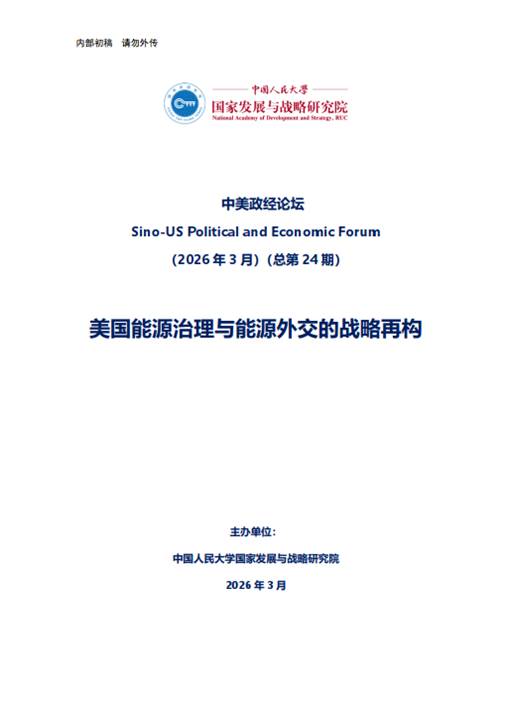
On March 30, 2026, the 24th Sino-U.S. Political and Economic Forum, hosted by the National Academy of Development and Strategy (NADS) at Renmin University of China, was livestreamed online. The forum was moderated by ZHAO Yong, Research Fellow at NADS and Professor at the School of Economics, Renmin University of China.
The report “Strategic Reconfiguration of U.S. Energy Governance and Energy Diplomacy” was authored by a research team led and convened by Associate Professor XU Yanran, Deputy Director of the Center for International Strategy Studies at NADS, and a faculty member of the School of International Studies. Distinguished experts and scholars in related fields, including DAI Changzheng, SHI Xunpeng, SONG Feng, WANG Lining, and YU Hongyuan, jointly provide in-depth analysis and discussion.
The first session featured the release of the report “Strategic Reconfiguration of U.S. Energy Governance and Energy Diplomacy” by Associate Professor XU Yanran.
The report focused on the following key themes:
1. The macro landscape of U.S. energy governance
2. The structural logic and operational mechanisms of energy governance institutions
3. The current state and bottlenecks of contemporary U.S. energy governance
4. The strategic reconfiguration of energy diplomacy and its geopolitical spillover effects
5. Core conclusions and future prospects
In the second session of the forum, the experts engaged in in-depth discussions on relevant topics and the content of the report.
Professor DAI Changzheng, head of the Division of Political Science, dean of the School of International Relations, and dean of the Institute for National Security and Governance at the University of International Business and Economics, highly praised the report’s research on U.S. energy governance and diplomacy, noting that its topic precisely captures a key domain of global political and economic affairs.
Professor SHI Xunpeng, chief researcher at the Australia-China Relations Institute of the University of Technology Sydney and President of the International Society for Energy Transition Studies, drew on the report’s findings to propose three core insights from the perspective of global energy governance, and further extended them into a systematic reflection on building China’s international discourse power in the clean technology industrial chain.
Professor SONG Feng, professor at the School of Applied Economics and Director of the Department of Energy Economics at Renmin University of China, conducted a comparative analysis of the power systems and regulatory frameworks of China and the United States. Using the surge in electricity demand driven by artificial intelligence as an entry point, he revealed the structural impact of institutional differences on energy governance capacity.
WANG Lining, an expert at the China National Petroleum Corporation Economics and Technology Research Institute, drew on the research report to systematically elaborate on five dimensions: the elevation of energy’s strategic attributes, a comparative assessment of governance system effectiveness, the coordination between institutional development and transition, the logic of domestic–international linkages, and China–U.S. cooperation under the framework of global governance.
Professor YU Hongyuan, distinguished Professor at the School of Political Science and International Relations at Tongji University and Executive Director of the Center for Polar and Oceanic Studies, built on the report to extend the analysis of the complexity of U.S. energy governance and diplomacy from three dimensions: institutional structure, historical evolution, and uncertainty.
Proofreaders: ZHAO Yong, XU Yanran
Translator: ZHANG Yuqing
Web Editor: ZHANG Jingjing