


 Research Update
15
April
In March 2026, with the approval of the State Council, the National Development and Reform Commission and the Office of National Working Committee on Children and Women under the State Council, jointly issued a guideline to advance child-friendly development across the society.
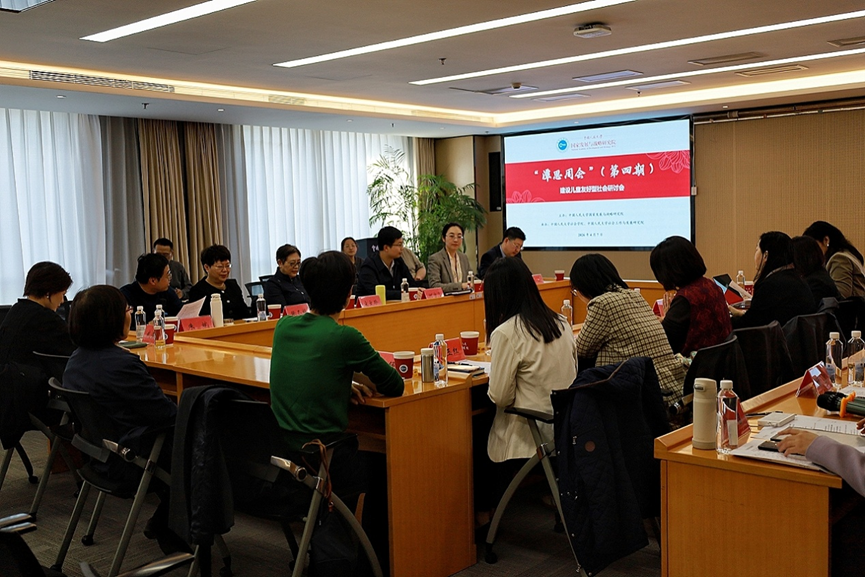
On April 7, the fourth TANSI Weekly Forum, titled “Seminar on Building a Child-Friendly Society”, was held. The event was hosted by the National Academy of Development and Strategy at Renmin University of China and organized by the School of Social Research and the Institute of Social Work and Development at Renmin University of China.
The seminar featured keynote speeches by SONG Wenzhen, former Executive Deputy Director of the Office of the State Council Working Committee on Women and Children; HE Yufei, Second-Level Principal Staff Member of the General Affairs Division of the Department of Social Development at the National Development and Reform Commission; and ZHANG Dongmei, Principal and Deputy Party Secretary of the Primary School Affiliated to Renmin University of China. Distinguished experts participating in the discussion included ZHANG Jing, former Chief Planner of the China Academy of Urban Planning and Design and Director of the Women Planners Committee of China Association of City Planning; ZHU Xiaoyu, Director of the Research Department at the China National Children’s Center; YU Xukun, Executive Director of the Beijing Children’s Legal Aid and Research Center; Professor HE Ling from China Youth University of Political Studies; Associate Research Fellow WEI Yifang from the Institute of Social Development at the Academy of Macroeconomic Research; and Professor ZHU Yuhong from the School of Social Research at Renmin University of China. TANG Ying, Party Secretary of the School of Social Research at Renmin University of China, delivered concluding remarks. Nearly one hundred experts, scholars, faculty members, and students from both within and outside the university attended the event, including WANG Wei, Deputy Dean of the National Academy of Development and Strategy at Renmin University of China, and researchers SUN Xiaoshu and WU Yingying from the China National Children’s Center. The seminar was chaired by ZHU Bin, Associate Dean of the School of Social Research and Executive Director of the Institute of Social Work and Development at Renmin University of China.
Director SONG Wenzhen delivered a keynote report titled “Deepening the Concept of Child-Friendliness and Building a Child-Friendly Society”. In her presentation, she systematically reviewed the development path of building a child-friendly society in China, shared the experiences and achievements of child-friendly city initiatives across the country, and outlined future pathways for development. She noted that China’s efforts to build child-friendly cities have gone through four stages, emergence, initial development, full-scale launch, and deepened implementation. Through this process, China has forged a distinctive path in safeguarding children’s rights within urban development. Significant achievements include accelerated progress in the rule of law, breakthroughs in inclusive welfare systems, strengthened protection for children in especially difficult circumstances, and notable improvements in children’s activity spaces. Looking ahead, she proposed four key approaches: deepening the concept of child-friendliness across society with a focus on humanistic values; accelerating the implementation of child-priority development policies under the guidance of social policy; promoting the development of child-friendly rural areas with an emphasis on public services and child-friendly spaces; and building a grassroots child protection system based on urban and rural communities.
HE Yufei, taking "Interpretation of 'A Guideline to Advance Child-friendly Development across the Society'" as the topic, elaborated on the background and main content of the document's formulation. He noted that the formulation of the policy is based on four essential imperatives: cultivating the next generation as a driving force for the future and advancing Chinese modernization; responding to declining birth rates and population aging while improving population development strategies; addressing the urgent concerns and practical difficulties faced by the public in the new era and meeting people’s aspirations for a better life; and advancing a people-centered new urbanization strategy to promote high-quality urban development. He summarized the key points of the guideline as follows: expanding scope—from pilot programs to comprehensive coverage across both urban and rural areas; focusing on priorities—ensuring that public policies incorporate a child perspective, public facilities reflect child-friendliness, and public services prioritize children; safeguarding the baseline—upholding children’s safety as a fundamental bottom line and strengthening institutional and social protection; and improving mechanisms—promoting the normalization and sustained advancement of child-friendly development. He emphasized that child-friendliness has become an important lever for coordinating work related to children, making social welfare more responsive and humane, and serving as a key narrative theme for telling China’s story effectively.
Principal ZHANG Dongmei delivered a report titled “Collaborative Education among Families, Schools, and Communities: Building a Child-Friendly Educational Ecosystem.” She pointed out that collaboration among families, schools, and communities represents an important direction in educational reform in the new era. To this end, the Primary School Affiliated to Renmin University of China has established an integrated “one body, dual drivers” model of collaborative education, with school education as the core, and with family nurturing capacity and social support capacity as the two driving forces. This model is implemented through three main practical pathways: First, schools take the initiative and assume primary responsibility for education. Beyond improving physical infrastructure such as campus facilities, schools should serve as platforms for children’s healthy development and joyful growth. Second, families and schools collaborate for mutual development. Through interactive engagement and organizational empowerment, families become active partners, forming a strong synergy in co-education. Third, communities are mobilized for co-governance. Schools are transformed from single actors into platforms for collaborative governance, where social forces become genuine partners, fostering a new governance model characterized by mutual trust and symbiotic development between schools and communities.
During the discussion session, several experts engaged in in-depth exchanges on the key priorities and challenges of building a child-friendly society, drawing on their respective research and practical experience.
ZHANG Jing, from the perspective of urban planning, pointed out that child-friendly development has become an important indicator of high-quality urban development in many cities. She noted that the newly issued policy emphasizes promoting models such as “neighborhood+”, “community+”, and “park+”, and advancing the coverage of inclusive facilities such as school commuting routes, pocket parks, and community micro-spaces. This reflects the comprehensive implementation of child-friendly principles in urban planning and development. She stressed that child-friendliness goes beyond spatial construction; it represents an overall enhancement of social, economic, cultural, and urban quality, generating a shift from “addition” to “multiplication” effects.
ZHU Xiaoyu emphasized that social consensus should evolve from “knowing children” to “understanding children”, and further to “supporting children”, with policies implemented from a child-centered perspective. In terms of research support, she highlighted the need to strengthen policy effectiveness evaluation and to refine theoretical insights based on China’s institutional strengths. In practice, she suggested integrating child protection into everyday services through family education, child-friendly community building, professional training in child social work, and digital empowerment.
YU Xukun noted that the protection of children’s rights is a fundamental component of child-friendliness, and that legal safeguards constitute the bottom line of building a child-friendly society. From a legal perspective, she proposed further improving mechanisms such as mandatory reporting systems, background checks for criminal records, and the “Five Musts” requirements. She also emphasized strengthening safety responsibilities in public spaces, increasing accountability for violations of children’s rights, and enhancing multi-disciplinary protection for affected children.
Professor HE Ling, from a demographic perspective, pointed out that the decline in the child population highlights the importance of improving the quality of the child population. She argued that child-friendly policies should not only directly benefit children but also strengthen the pathway of “state supports families, families support children”, with a focus on economic support, time support, and service provision. She further emphasized the need to promote high-quality, sustainable development, coordinate the advancement of child-friendly spaces, and prioritize safety, autonomy, and development to foster children’s all-round growth and contribute to national development and rejuvenation.
Associate Research Fellow WEI Yifang stated that advancing child-friendly development should fully implement the new development philosophy, leverage innovation as a driving force, and promote regional cooperation and exchange, creating natural and ecologically sound environments for children’s growth. She emphasized adopting a global perspective, deepening mutual learning, and continuously enhancing children’s sense of gain and well-being by focusing on their needs.
Professor ZHU Yuhong shared reflections from the perspective of social work. She noted that, on the basis of consolidating protective, substitute, supplementary, and supportive services, the child social work service system can further expand toward developmental services and greater child participation. She also highlighted the importance of promoting the professionalization and specialization of the child social work workforce to provide strong talent support for building a child-friendly society.
TANG Ying delivered the concluding remarks. She stated that the seminar was a highly intensive, high-quality, and high-level interdisciplinary exchange, successfully achieving its intended goals of “bringing together wisdom, deepening understanding, building consensus, and inspiring the future”. She emphasized that building a child-friendly society may be a long and challenging journey, but with sustained effort, it is both attainable and achievable. It requires continuous deepening of theoretical research, strengthened policy innovation, and active practical exploration. More importantly, it calls on everyone to internalize the concept of child-friendliness and translate it into concrete action. She added that the School of Social Research and the National Academy of Development and Strategy at Renmin University of China will continue to provide platforms for dialogue and collaboration, contributing academic insights and policy solutions to advance the high-quality development of child-friendly initiatives in China and to create a better environment for children’s growth.
This session of TANSI Weekly Forum, focusing on the major livelihood issue of building a child-friendly society, carried out systematic and in-depth discussions on key topics such as conceptual development, policy implementation, practical innovation, and multi-sectoral collaboration. It further consolidated consensus on advancing child-friendly development across society and provided valuable theoretical support and practical references for promoting high-quality development of child-friendly initiatives in the new stage.
Proofreaders: WANG Wei, ZHU Bin
Translator: ZHANG Yuqing
Web Editor: ZHANG Jingjing
Introduction to the Innovation Hub
The Institute of Social Work and Development at Renmin University of China was established in 2023. It serves as an innovative research hub founded by the university. Relying primarily on the first-level discipline of sociology, the Institute integrates resources from within and beyond the university, both domestically and internationally. It conducts theoretical and policy research on major strategic issues in social governance during the new stage of development, promotes the construction of an independent knowledge system for social governance, and advances a co-governance model characterized by joint participation, shared responsibility, and shared benefits. The Institute is committed to developing a “people-centered” model of social work and strives to become a nationally renowned center for innovative research in social governance as well as a new-type think tank.
About TANSI Weekly Forum
The “TANSI Weekly Forum” is a high-level interdisciplinary discussion platform established by the National Academy of Development and Strategy at Renmin University of China. Focusing on frontier academic and policy issues, the forum brings together the intellectual strengths of the university’s innovation hubs as well as leading scholars and policy experts across sectors. Through in-depth exchanges and discussions, the forum aims to produce high-quality think tank achievements characterized by strategic vision, contemporary relevance, and intellectual depth. It serves as an important platform for advancing knowledge innovation, theoretical innovation, and policy innovation, while promoting the mutually reinforcing relationships between academic disciplines, policy consultation, and think tank development.