


 Research Update
20
May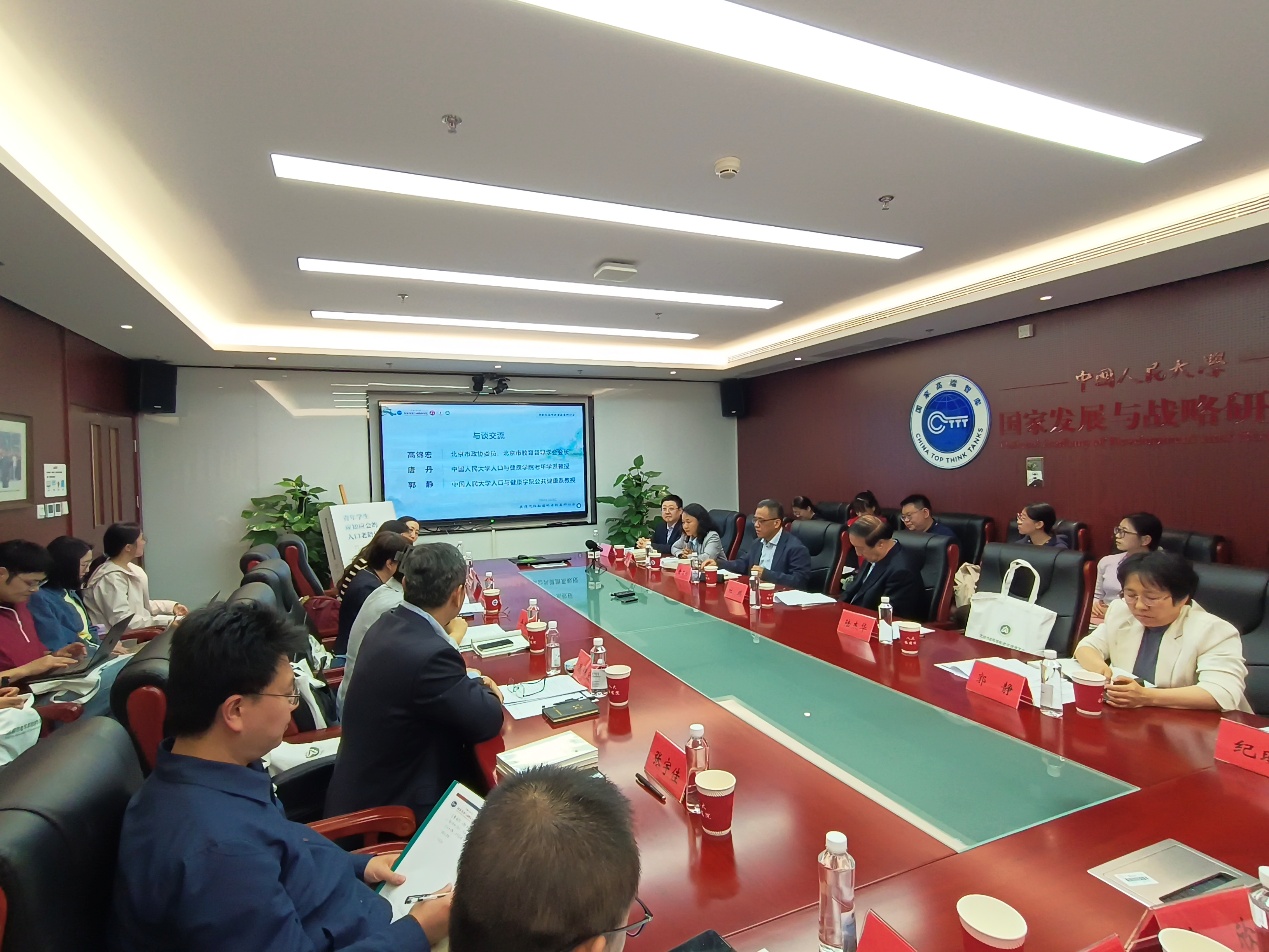
The Guiding Opinions on Further Conducting National Education on Population Aging, issued in 2025, clearly puts forward the requirement of “carrying out national education on population aging in a categorized manner”, makes special arrangements for “strengthening national education on population aging among young people”, and points out the direction for deepening such national education for the general public and young generations.
On April 23, 2026, the Sixth TANSI Weekly Forum, titled “Seminar on National Aging Situation Education Policy”, was successfully held. The event was hosted by the National Academy of Development and Strategy, Renmin University of China, and co-organized by the School of Population and Health, China Institute of Health at Renmin University of China, and the Beijing Gerontological and Geriatric Health Society. The conference was co-chaired by WANG Wei, Vice Dean of the National Academy of Development and Strategy, Renmin University of China, and SUN Juanjuan, Professor at the School of Population and Health, Renmin University of China, as well as Vice President and Secretary-General of the Beijing Gerontological and Geriatric Health Society. YUE Linlin, Deputy Director of the Publicity Department of the China National Committee on Aging, and BAI Ling, Second-Level Inspector of the Beijing Municipal Aging Association, delivered remarks. HUANG Shisong, Senior Research Fellow of the National Academy of Development and Strategy at Renmin University of China, Special National Supervisor, and President of the Beijing Gerontological and Geriatric Health Society, delivered the keynote speech. GAO Jinhong, Member of the Beijing Municipal Committee of the Chinese People’s Political Consultative Conference and President of the Beijing Education Supervision Society; TANG Dan, Professor of the Department of Gerontology, School of Population and Health, Renmin University of China; and GUO Jing, Professor of the Department of Public Health, School of Population and Health, Renmin University of China, participated in the panel discussion and exchange. LU Jiehua, Wu Yuzhang Distinguished Professor and Professor of the School of Population and Health, Renmin University of China; ZHANG Yujia, Librarian of the High School Affiliated to Renmin University of China; JI Xiaoli, Teacher of the High School Affiliated to Beijing Institute of Technology; GU Fangcheng, student from People’s Public Security University of China; LV Lidan, Associate Professor of the Department of Demography, School of Population and Health, Renmin University of China; DONG Zhengmin, Director of the Humanities and Academic Department at Beijing Lunyang Book Publishing Company of Beijing Publishing Group, participated in the open discussion. DU Peng, Former Vice President of Renmin University of China, Dean of the School of Population and Health, Director of China Institute of Health, and Director of the Institute of Gerontology, delivered the concluding comments. Experts and scholars in relevant fields as well as faculty and student representatives attended the seminar.
Deputy Director YUE Linlin of the Publicity Department of the China National Committee on Aging pointed out that population aging is a long-term and strategic issue running through the advancement of Chinese modernization. Carrying out national education on population aging serves as a fundamental project to implement central government arrangements and build social consensus. China National Committee on Aging will focus on promoting the regular and institutionalized delivery of such national education on campus, guiding young people to foster awareness of endowment preparation across the life course, promote the culture of respecting and caring for the elderly, and advance intergenerational harmony. Meanwhile, it will innovate educational forms and communication approaches to make relevant content appealing, understandable and applicable to young students.
Inspector BAI Ling stated that centering on youth aging national education and building an age-friendly society with intergenerational harmony, this seminar is well aligned with practical needs and bears far-reaching significance. Going forward, the Beijing Civil Affairs Bureau will coordinate with all parties to promote national education on population aging into government authorities, Party schools, campuses, communities, enterprises and elderly service institutions, and popularize the concepts of a positive outlook on aging and healthy aging. She expressed the hope that taking this seminar as an opportunity, think tanks and social forces will be gathered to explore youth-oriented educational approaches, so as to jointly contribute to the development of elderly care undertakings in the capital city.
In the keynote speech session, Research Fellow HUANG Shisong delivered a keynote report entitled “When Generation Z Meets Population Aging: Reflections on National Education on Population Aging”. He introduced that the compilation of Essential Knowledge on Population Aging for Young Students was inspired by an eye-opening research activity of the middle school student model Chinese People’s Political Consultative Conference. The elderly care issues raised by young students are pointed and realistic, fully demonstrating that teenagers are closely connected with population aging. He pointed out that contemporary young people will inevitably face the dual pressure of family caregiving and societal population aging in the future, making it urgent for them to establish a scientific understanding of aging from adolescence onwards. Centering on national macro conditions, outlooks on health, family, marriage and childbearing, perceptions of aging, and the construction of an all-age-friendly society, the reading book responds to young people’s concerns with plain language and real-life cases. He argued that current national education on population aging still faces problems such as insufficient coverage, mismatch between supply and demand, and monotonous communication methods. It is necessary to move the educational frontier forward, shift the focus down to grassroots levels, and integrate aging education into campus and daily life scenarios. Drawing on practical experiences from multiple regions, he proposed innovating educational models, advancing school-community collaboration and intergenerational coexistence, embedding national aging education into community public spaces and family service scenarios, expanding its functional orientation, achieving all-age coverage and intergenerational integration, and enabling such education to be truly practical, effective and deeply rooted in people’s minds.
Coinciding with World Book Day on April 23, the seminar held concurrently the new book launch ceremony of “Essential Knowledge on Population Aging for Young Students”. BAI Ling, Second-Level Inspector of the Beijing Municipal Aging Association, and DU Peng, Dean of the School of The Population and Health, Renmin University of China, jointly unveiled the new book. Thereafter, HUANG Shisong, chief editor of the book, and DONG Zhengmin from Beijing Publishing Group, on behalf of the compilation team and the publisher respectively, donated copies of the book to ZHANG Yujia, Librarian of the High School Affiliated to Renmin University of China, to facilitate the integration of national education on population aging into campus life.
Subsequently, participating experts engaged in in-depth exchanges around the theme.
President GAO Jinhong noted that population aging constitutes a major national reality that China must confront, exerting an overall and strategic impact on economic and social development. The holding of this seminar together with the new book launch is well-timed, fully demonstrating the sense of responsibility and commitment of the top-tier national think tank at Renmin University of China. He spoke highly of “Essential Knowledge on Population Aging for Young Students”, stating that the book focuses on young people’s concerns and responds to social realities, possessing both practical significance and strategic value. He pointed out that society as a whole is generally inadequately prepared for the challenges of population aging, and it is imperative to strengthen the government’s fundamental guarantee responsibilities and enhance national condition education as well as public communication and guidance.
Professor LU Jiehua succinctly summarized the characteristics of the book with “three dimensions of multiplicity”. First, “multi-stage coverage”: it runs through the entire life cycle, the whole process and all groups of people, enabling young people to understand population aging from a broad long-term perspective. Second, “multi-scenario coverage”: it spans all areas of life including health, family, marriage, childbearing and elderly care, closely resonating with young people’s real life. Third, “multi-stakeholder participation”: it emphasizes shared responsibilities among the government, society, families and individuals. He stressed that national education on population aging is of crucial importance, with education targeting leading cadres standing as the top priority. Relevant content should be incorporated into the curriculum of Party schools, so as to foster sound public awareness and drive the whole society to actively respond to population aging.
Professor TANG Dan shared the original intention behind compiling the book and offered relevant educational suggestions. She pointed out that population aging is not merely an issue for the elderly, but a long-term topic spanning the entire life cycle. The general public generally lacks such awareness and tends to regard population aging as a social burden. The compilation team intends to help young students view aging objectively from a life-course perspective through this reading book, and guide them to connect their current study and life with future retirement and elderly care preparation.
Professor GUO Jing elaborated on the compilation rationale and core content of the chapter on health perception in the book. She designed the chapter based on the needs of teenagers. Starting from the definition of health and the characteristics of health in old age, the chapter guides young people to establish a correct outlook on health, illness and death, and foster a scientific concept of pursuing not merely longevity, but quality of life.
Subsequently, other participating representatives also shared their insights based on their respective practical experience. Library Director ZHANG Yujia noted that middle school students lack intuitive experience of aging-related issues. Carrying out national education on population aging at the basic education stage should not only popularize knowledge of population structure, but also cultivate students’ awareness of social governance and sense of responsibility. Teacher JI Xiaoli emphasized that senior high school students generally hold misunderstandings about population aging. As this period is crucial for value shaping, it is urgent to integrate national education on population aging into ideological and political teaching. GU Fangcheng, the youth student representative, drawing on his own research experience, stated that professional popular science readings can help young people break through superficial perceptions and recognize the connection between population aging and their personal development. Associate Professor LV Lidan, based on her experience in compiling the book, argued that it is highly necessary and urgent to disseminate knowledge about population aging among teenagers. Macroeconomic and demographic patterns profoundly affect young people’s life planning, and popular science can support their rational development. From a publishing perspective, Director DONG Zhengmin stated that his institution will strengthen the promotion and dissemination of popular science books on aging, deepen multi-party cooperation, advance the transformation and implementation of aging research achievements, and give full play to the public social value of aging science popularization.
Professor DU Peng delivered the concluding remarks. He pointed out that this is the first reading book in China specially tailored for young students on national education regarding population aging, and its publication comes at a highly critical time. The younger generation will live deeply into a super-aged society in the future and face multiple challenges brought by elderly care and social development, making it particularly important for them to establish a positive outlook on aging at an early age and make long-term plans. He fully affirmed that the content of the book closely caters to the needs of young people and carries far-reaching value. Meanwhile, he suggested diversifying communication approaches, expanding coverage through new media forms such as short videos, themed competitions and lecture campaigns, and encouraging teachers and students to jointly participate in content creation and sharing so as to enrich educational resources. Through multi-channel promotion and the integration of resources from all sides, the book can be truly incorporated into campus teaching and daily public education, continuously amplifying the practical effectiveness of national education on population aging.
Carrying out national education on population aging across society is a key initiative to implement the spirit of General Secretary Xi Jinping’s important speeches and instructions on strengthening work related to the elderly, and a fundamental project for advancing the national strategy of actively responding to population aging. This seminar, focusing on the needs of the times and pooling wisdom from multiple sectors, has provided strong academic support and policy references for advancing the systematic development, targeted implementation, practical application and institutional guarantee of national education on population aging. The event has established a high-level platform for academic exchanges, helping to enhance public scientific understanding of population aging, promote the traditional Chinese virtues of respecting and caring for the elderly, and build broad consensus and collective action for fostering an age-friendly society characterized by intergenerational harmony, shared development and common benefits.
Proofreaders: WANG Wei, HUANG Shisong
Translator: ZHANG Yuqing
Web Editor: ZHANG Jingjing
Introduction to the Innovation Hub
China Institute of Health at Renmin University of China is an interdisciplinary research institute jointly built by Renmin University of China together with internal and external institutions at home and abroad. Aligning with the major strategic needs for advancing the Healthy China Initiative set forth in the Report to the 20th National Congress of the Communist Party of China, the Institute pursues high-standard, interdisciplinary and multi-institutional co-construction. It systematically integrates strengths scattered across various disciplines, schools and research institutes of the University. By continuously improving institutional mechanisms and pooling resources, it has established a centralized, specialized and high-level operating institution centered on Healthy China research, undertaking high-standard and high-caliber work in scientific research, high-end think tank services, and talent cultivation. Focusing on the macro strategy, institutional system and policy innovation of the Healthy China Initiative, the Institute strives to build an academic highland and distinctive research strengths, form a research network that unites multi-party forces across the country, and develop into a national research center in the field of Healthy China. It also disseminates and exchanges practical experience and innovative measures of the Healthy China Initiative to the world, and builds a corresponding international training platform.
China Institute of Health at Renmin University of China consistently focuses on three major areas: it pays attention to health-related initiatives including government, social and market initiatives, conducts research on health governance covering individual governance, group governance and social governance, and supports the development of the health industry with a focus on the aging industry and medical and health care by integrating industry, academia and research. Through research in the above three areas, the Institute provides holistic and comprehensive support for the Healthy China Strategy.
Through continued investment and internal cohesion plus external collaboration, China Institute of Health will develop a scaled-up institutional system and a high-level research platform in fostering emerging disciplines, advancing organized scientific research, generating achievements for the independent knowledge system, and building a high-end think tank. It will grow into a top-tier domestic and international pioneering innovation base, high-end think tank and talent training center for Healthy China research. In scientific research, it will serve as a frontier innovation base for theoretical studies in population development, healthy aging, public hospital management, public health system development, medical and healthcare system reform, as well as health economics and policy evaluation. In social services, it will act as a high-end policy advisory platform for the Party and the government in making major decisions on the strategic arrangements and policy measures of advancing the Healthy China Initiative. In talent cultivation, it will function as a key institute for nurturing high-level professionals committed to the development of Healthy China. In domestic and international academic exchanges, it will serve as an important gateway for presenting China’s practices in advancing the Healthy China Initiative and offering Chinese solutions to global health governance.
About TANSI Weekly Forum
The “TANSI Weekly Forum” is a high-level interdisciplinary discussion platform established by the National Academy of Development and Strategy at Renmin University of China. Focusing on frontier academic and policy issues, the forum brings together the intellectual strengths of the university’s innovation hubs as well as leading scholars and policy experts across sectors. Through in-depth exchanges and discussions, the forum aims to produce high-quality think tank achievements characterized by strategic vision, contemporary relevance, and intellectual depth. It serves as an important platform for advancing knowledge innovation, theoretical innovation, and policy innovation, while promoting the mutually reinforcing relationships between academic disciplines, policy consultation, and think tank development.