


 TANSI Weekly Forum
27
May
President Xi Jinping has profoundly pointed out: “China’s ancient legal system embodies rich wisdom and resources, and the Chinese legal system stands uniquely among the world’s major legal systems. We must pay attention to studying the traditions, successes and failures of China’s ancient legal system, explore and inherit the essence of Chinese legal culture, draw nourishment, and adopt what is good”. This important statement highlights the distinctive feature of Xi Jinping Thought on the Rule of Law, which adheres to integrating Marxist rule of law theory with China’s fine traditional legal culture. It provides fundamental guidance for us to draw wisdom from history and strengthen confidence in the path of socialist rule of law with Chinese characteristics.
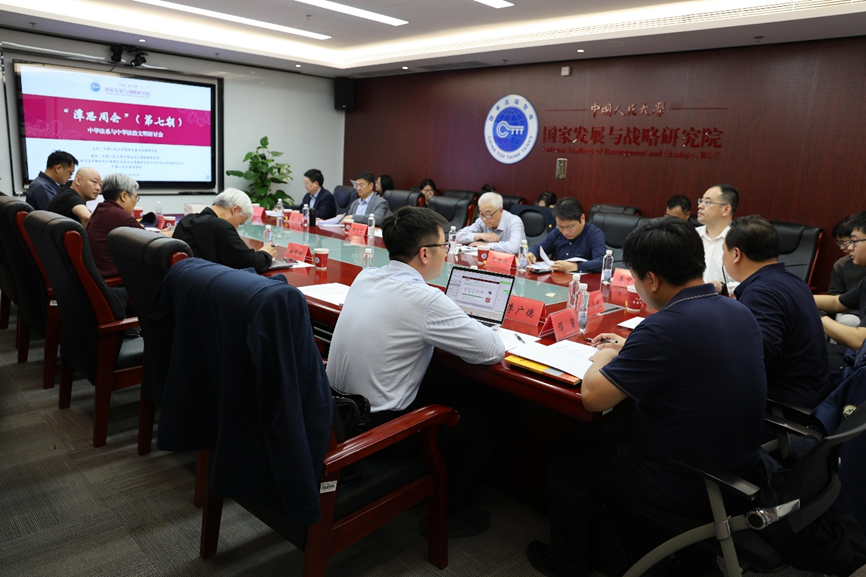
On the afternoon of April 24, 2026, the Seventh TANSI Weekly Forum, titled “Seminar on the Chinese Legal System and Chinese Legal Civilization” was successfully held. It was hosted by the National Academy of Development and Strategy (NADS) at Renmin University of China, and co-organized by the Advanced Institute of Chinese Rule of Law Civilization at Renmin University of China, the Research Center for Xi Jinping Thought on the Rule of Law of the Academy of Xi Jinping Thought on Socialism with Chinese Characteristics for a New Era at Renmin University of China, and Law School at Renmin University of China.
The conference specially invited WANG Limin, former Vice President, Second-level Professor of East China University of Political Science and Law, and Executive President of the China Institute of Legal History; and ZHANG Sheng, Second-level Researcher at the Institute of Law, Chinese Academy of Social Sciences, and President of the China Institute of Legal History, to deliver keynote speeches respectively. Participating in the panel discussion were YAO Zhongqiu, Professor at the School of International Studies, Renmin University of China; MA Xiaohong, Second-level Professor at the Law School, Renmin University of China; LIU Xinjie, Dean and Professor of the Law School, Sichuan University; and WANG Shuaiyi, Associate Researcher at the Institute of Law, Chinese Academy of Social Sciences, and Secretary-General of the China Institute of Legal History. YOU Chenjun, Professor at the Law School, Director of the Jurisprudence Teaching and Research Office, and Deputy Editor-in-Chief of The Jurist, delivered a concluding commentary. The event was also attended by LI Zhonghua, Director of the Trial Management Office of the People’s Court of Tongzhou District, Beijing; LIANG Xisheng, Associate Professor at the School of Administrative Law, Southwest University of Political Science and Law; WANG Wei, Vice President of the National Academy of Development and Strategy, Renmin University of China; XIAO Qiushi, Editor at Renmin University of China Press; LI Guangde, Associate Professor at the Law School and Secretary-General of the Research Center for Xi Jinping Thought on the Rule of Law, Renmin University of China; as well as other experts, scholars, teachers and students from inside and outside the university engaged in jurisprudence, legal history and other related fields.
Professor PENG Xiaolong, Deputy Party Secretary and Secretary-General of the Commission for Discipline Inspection of the Law School at Renmin University of China, presided over the conference. He stated that the Chinese legal system stands unique in its own right, embodying the great creativity of the Chinese nation and the profound heritage of Chinese legal civilization, and contains numerous fine ideas and concepts worthy of inheritance. Bringing together experts and scholars in law, political science, history and other fields, the seminar aims to systematically sort out the evolutionary context and core characteristics of the Chinese legal system from an interdisciplinary perspective, and further explore the jurisprudential thoughts and governance wisdom behind it.
Professor WANG Limin delivered a keynote speech entitled The Chinese Legal System and the World’s Legal Systems. He mainly elaborated on four major points. First, every legal system in the world consists of three core elements: the mother country, member states, and the channels connecting the mother country and member states. Among them, the mother country occupies the core position, member states the subordinate position, and connecting channels the pivotal position. Second, all legal systems across the world take shape and develop in an open context. Openness is an inherent attribute of legal systems and serves as the driving force behind their formation and development. The establishment, institutional connotations, and evolution of legal systems all feature openness. Third, among the world’s five major legal systems, the Chinese legal system is distinctive and unparalleled. It is the earliest secular legal system formed entirely through non-violent means, the first to possess departmental law codes, and its connotations are imbued with the fine traditional legal culture of the Chinese nation. Fourth, the prospect of reviving the Chinese legal system is growing increasingly promising. This is attributable to China’s rising comprehensive national strength, continuous advancement of cultural and civilizational attainment, as well as its advanced and distinctive practice of the rule of law.
Researcher ZHANG Sheng delivered a keynote speech entitled Reflections on Theoretical Paradigms: The Chinese Legal System and Chinese Rule of Law Civilization. He first reflected on the self-sufficiency and adequacy of the theoretical paradigm of the Chinese legal system, pointing out that as a traditional theoretical paradigm, the Chinese legal system has shortcomings such as an imperfect logical framework, gaps in its chronological span, and ambiguity and polysemy in conceptual connotations. Accordingly, he proposed that the governance system of Chinese civilization can be summarized as a co-constructed rule of law system, namely a unified political and ethical system of great unification. This system remained consistent from Chapters Outside the Book of Zhou to Commentary on the Tang Code and The Code of Qing Dynasty. It constitutes a comprehensive governance system encompassing value concepts, organizational mechanisms, normative systems, and educational guidance, and can connect with the contemporary political and legal system through sublation and inheritance. The co-constructed rule of law system in ancient China can be embodied in four basic categories: the people-oriented legal philosophy, the organizational mechanism of integration with division of functions, the legal system formulated with statutes and rules, and legal evolution featuring inheritance and development. He stressed that it is necessary to advance theoretical improvement and innovative development of the Chinese legal system, align the traditional governance system with the modern political and legal system, and enable the Chinese legal system to achieve greater self-consistency within a unified logical framework.
Following the keynote speeches, participating experts conducted in-depth discussions and exchanges around the theme of the seminar.
Centering on historical jurisprudence, Professor YAO Zhongqiu shared several reflections. Drawing on the theoretical logic of Savigny’s paradigm of historical jurisprudence, he pointed out the priorities of current independent research on historical jurisprudence. First, to study Western law through a historical approach, contextualize it historically, and reveal its temporality and locality. Second, to conduct in-depth research on China’s traditional law. Third, to focus on studying the rule of law practices of the Communist Party of China. He finally proposed that we should explore the establishment of Party history political science or the legal history of the Communist Party of China, so as to thoroughly explore the theoretical innovations and historical contributions of the Party in the practice of rule of law.
Professor MA Xiaohong first traced the historical origin of the concept of the Chinese legal system, pointing out that legal systems are epochal in nature and distinguishing between ancient law and traditional law. She argued that when viewing the Chinese legal system as a whole, we must discard the false and retain the true, and eliminate the crude while preserving the refined. Compared with the concept of the Chinese legal system, she advocated adopting Chinese rule of law civilization, a concept with richer connotations and a broader vision. It is essential to stay rooted in our heritage, draw on foreign achievements, and embrace the future, so as to promote the creative transformation and innovative development of fine traditional rule of law culture.
Professor LIU Xinjie noted that the term “Chinese legal system” has deviated from its original meaning in contemporary discourse and can be defined as Chinese rule of law civilization with East Asian influence and even global significance. This concept emphasizes interpreting Chinese rule of law civilization from a holistic and global perspective. He also introduced An Introduction to the Chinese Legal System, which he edits, offering a comprehensive collation of the basic categories, institutions and spirits of the Chinese legal system. Taking the spread of traditional Chinese law in non‑English‑speaking countries as an example, he proposed further broadening the international vision of research on the Chinese legal system.
Associate Researcher WANG Shuaiyi commented that Professor WANG Limin and Researcher ZHANG Sheng interpreted the Chinese legal system respectively from the perspectives of comparative law and legal history in a concise, comprehensive, in‑depth and lucid manner. He held that as the world’s earliest secular legal system, the Chinese legal system boasts strong vitality tempered by history and remarkable modern relevance. Its creative transformation and innovative development should not only align with mainstream values, but also seek coherence between the East and the West, and between tradition and modernity.
During the open discussion session, the guest speakers engaged in interactive exchanges in response to questions raised by teachers and students present at the event.
Professor YOU Chenjun delivered the closing remarks and comments on the event. He noted that today’s discussions centered on four major aspects: first, how to define the connotation and denotation of the concept of the “Chinese legal system”; second, how to view the proposition of “reviving the Chinese legal system” put forward by some scholars; third, how to understand the contemporary value and application of the concept of “legal system”; and fourth, how to tell the story of Chinese rule of law civilization in an era of civilizational competition well. He advocated adopting the concept of “Chinese rule of law civilization”, which carries stronger modern implications, while rationally recognizing the value of the concept of legal system. It is imperative to continuously enhance China’s cultural soft power, promote exchanges and mutual learning among civilizations, and effectively tell the story of Chinese rule of law civilization to the world.
Bringing together wisdom from all sides and focusing on key academic topics, this seminar has provided important academic support for advancing research on the Chinese legal system and Chinese rule of law civilization. The event has built a high-level platform for academic exchanges, further consolidated consensus, and laid a solid foundation for promoting the construction of an independent knowledge system of Chinese legal studies.
Proofreaders: WANG Wei, HUANG Wenyi
Translator: ZHANG Yuqing
Web Editor: ZHANG Jingjing
Introduction to the Innovation Hub
On May 17, 2023, to thoroughly implement the spirit of President Xi Jinping’s important speeches at the Symposium on Philosophy and Social Sciences and during his inspection tour of Renmin University of China, Renmin University of China held a ceremony to inaugurate the university’s Innovation Hubs. The university adopted the Overall Plan for the Reform and Upgrading of Scientific Research Institutions of Renmin University of China, and established the first batch of 16 Innovation Hubs, including the Advanced Institute for Chinese Rule of Law Civilization (hereinafter referred to as the “Advanced Institute”).
The Advanced Institute is headed by Professor HUANG Wenyi, former Dean of the Law School of Renmin University of China, with Professor WANG Xu, Dean of the School of Discipline Inspection and Supervision of Renmin University of China, serving as Executive Dean. It has two governing bodies: the Strategic Development Committee and the Academic Committee. Professor ZHANG Wenxian chairs the Strategic Development Committee, and Professor XU Xianming chairs the Academic Committee.
Since its establishment, the Advanced Institute has deeply grasped the profound implication that “the second integration represents another emancipation of the mind”. It has advanced research on the past, present and future of Chinese rule of law civilization, promoted the development of a new form of human rule of law civilization, and focused on core initiatives including the development of the Global Distinguished Scholars Forum on Chinese Rule of Law Civilization, the hosting of the High-end Series Conferences on Chinese Rule of Law Civilization Research, the solicitation and approval of major research projects, the publication of the Research Series on Chinese Rule of Law Civilization, and the release of the Academic Observation Report and Academic Innovation Index Assessment on Chinese Rule of Law Civilization.
About TANSI Weekly Forum
The “TANSI Weekly Forum” is a high-level interdisciplinary discussion platform established by the National Academy of Development and Strategy at Renmin University of China. Focusing on frontier academic and policy issues, the forum brings together the intellectual strengths of the university’s innovation hubs as well as leading scholars and policy experts across sectors. Through in-depth exchanges and discussions, the forum aims to produce high-quality think tank achievements characterized by strategic vision, contemporary relevance, and intellectual depth. It serves as an important platform for advancing knowledge innovation, theoretical innovation, and policy innovation, while promoting the mutually reinforcing relationships between academic disciplines, policy consultation, and think tank development.