


 Research Update
23
April
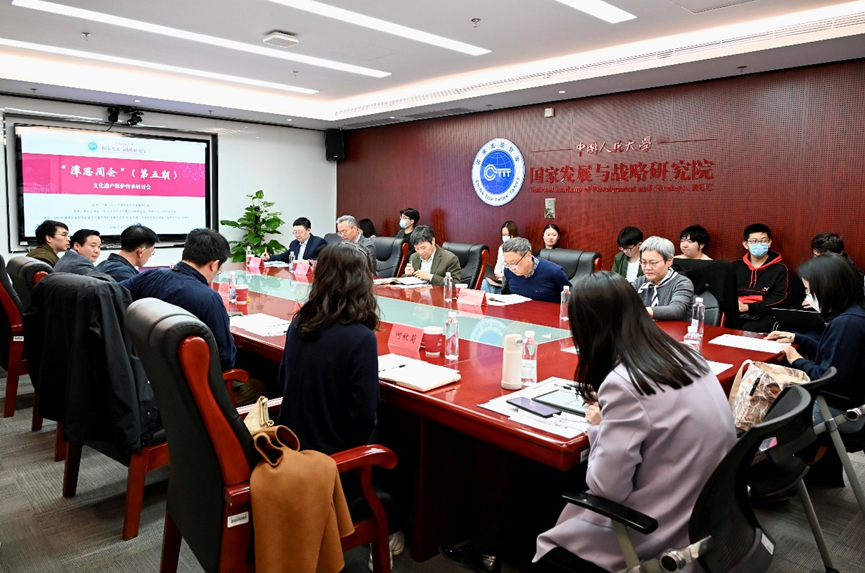
The recently released Outline of the 15th Five-Year Plan for National Economic and Social Development of the People’s Republic of China sets out dedicated arrangements for “strengthening the protection and inheritance of cultural heritage” in Chapter 34, “Vigorously Promoting the Prosperity of Cultural Undertakings”, thereby pointing the way for cultural heritage protection, inheritance, and the modernization of governance in the new era. On April 10, 2026, the Fifth TANSI Weekly Forum, titled “Seminar on Cultural Heritage Protection and Inheritance”, was successfully held. The event was hosted by the National Academy of Development and Strategy at Renmin University of China, and co-organized by the National Cultural Heritage Administration–Renmin University of China Institute of Innovative Cultural Heritage Study and the School of History at Renmin University of China.
The conference specially invited HANG Kan, Director of the Yungang Grottoes Cultural Research Institute and professor at the School of Archaeology and Museology of Peking University, and Professor WANG Yunxia, Chairholder of the UNESCO Chair on Cultural Heritage Law and professor at the Law School of Renmin University of China, to deliver keynote speeches. Participants in the discussion included GUO Jingning, a member of the Party Leadership Group of the Beijing Municipal Cultural Heritage Bureau and Director of the Capital Museum; Professor XU Yongjun, Director of the Information Center for Social Sciences and professor at the School of Information Resource Management of Renmin University of China; Associate Professor ZHANG Linhu, Deputy Director of the NCHA-RUC Institute of Innovative Cultural Heritage Study ; and Associate Professor HE Tianping, Deputy Director of the Department of Audio-Visual Communication at the School of Journalism and Communication, Renmin University of China. Professor LIN Shangli, former President of Renmin University of China and professor at the School of International Studies, delivered concluding remarks. The event was also attended by WANG Wei, Deputy Dean of the National Academy of Development and Strategy at Renmin University of China, along with other experts and scholars, as well as representatives of faculty and students from both within and outside the university in fields such as cultural heritage, archaeology and museology, legal governance, and journalism and communication. The conference was chaired by Professor LV Xueming, Director of the NCHA-RUC Institute of Innovative Cultural Heritage Study .
Professor HANG Kan delivered a keynote speech titled “Heritage and Tourism, Cultural Relics Protection and Cultural Inheritance”. Using the tourism boom at the Yungang Grottoes as an example, he pointed out that cultural heritage, as a precious non-renewable resource, must be protected with a focus on interpreting and transmitting its historical, artistic, and scientific values, thereby enhancing cultural identity and strengthening cultural confidence. In practice, the Yungang Grottoes Cultural Research Institute has adopted technological approaches such as 3D scanning and digital restoration to expand modes of presentation, while promoting targeted communication for different audiences. Professor Hang noted that cultural heritage protection and development still face three major challenges: an overemphasis on tourism at the expense of cultural value, insufficient interpretive efforts, and weak disciplinary development. He emphasized the need to transform mindsets and cultivate talent so that cultural heritage can truly be revitalized.
Professor WANG Yunxia delivered a keynote speech titled “Systematic Protection of Cultural Heritage Requires Legal Safeguards”. She observed that current cultural heritage protection faces issues such as unclear conceptual definitions, fragmented administrative responsibilities, and a weak awareness of holistic protection. She stressed the urgent need to establish a solid legal foundation for systematic protection. This includes accelerating the legislation of the Cultural Heritage Protection Law, revising and improving relevant regulations, strengthening coordination within the legal system, and exploring the establishment of a cultural heritage protection supervision mechanism, so as to ensure effective governance through robust institutional frameworks.
Following the keynote speeches, participating experts engaged in in-depth discussions on the theme.
Director GUO Jingning noted that cultural heritage encompasses diverse categories and involves multiple administrative bodies, making it urgent to establish a systematic protection framework. She emphasized the need to continuously strengthen efforts in improving top-level design, enhancing comprehensive capacities, reinforcing coordinated mechanisms, and expanding international communication, so as to further elevate the global influence of China’s outstanding traditional culture.
Professor XU Yongjun engaged in in-depth dialogue with the keynote speakers on the development of cultural heritage as an academic discipline and the improvement of the legal system. He explored the feasibility of establishing cultural heritage as a first-level discipline and formulating a specialized legal code, helping to build consensus on both disciplinary development and institutional construction.
Associate Professor ZHANG Linhu pointed out that cultural heritage protection urgently requires interdisciplinary talent. He called for accelerating the establishment of a first-level discipline in cultural heritage studies, addressing shortcomings in technological application and value interpretation, optimizing talent cultivation models, and strengthening both theoretical and practical foundations.
Associate Professor HE Tianping, drawing on his experience in producing cultural heritage-related media programs, emphasized that enhancing the communication impact of cultural heritage depends on translating grand narratives into accessible, popular expressions. By leveraging new media, it is possible to bring the public closer to cultural heritage, promote the integration of culture and tourism, and foster a stronger sense of presence and identity among audiences.
Professor LIN Shangli delivered the concluding remarks. He pointed out that the protection and inheritance of cultural heritage constitute an important mission in cultural development in the new era. Efforts should be grounded in the overall goal of building a culturally strong nation, with a deepened understanding and systematic planning from the perspectives of highlighting the profound foundations of Chinese civilization, strengthening the nation’s cultural accumulation, and enhancing the international influence of Chinese culture. He emphasized the need to clarify the relationship between cultural relics and cultural heritage, highlight their public nature, and improve the systems for protection, management, and utilization, thereby enhancing the overall coherence, coordination, and institutionalization of governance. He also stressed the importance of focusing on national strategic needs, accelerating disciplinary development and talent cultivation, and advancing innovation in theory, institutions, and practice, so as to establish an independent Chinese knowledge system and discourse system for cultural heritage. Furthermore, he underscored the importance of creating historical contexts, fostering cultural ecosystems, and promoting high-quality transformation and utilization, in order to continuously strengthen the public’s tangible perception of and cultural identification with Chinese civilization. He expressed hope that the National Cultural Heritage Administration–Renmin University of China Institute of Innovative Cultural Heritage Study would remain oriented toward national needs, deepen research and interpretation, promote practical innovation, and contribute to the development of a culturally strong nation.
This seminar brought together diverse perspectives and focused on key issues, providing important support for advancing the systematic protection of cultural heritage and improving governance capacity. The event established a high-level platform for academic exchange, further built consensus within the field, and laid a solid foundation for enhancing the dissemination of cultural heritage values and enabling the treasures of Chinese culture to gain renewed vitality in the new era.
Proofreaders: WANG Wei, LV Xueming
Translator: ZHANG Yuqing
Web Editor: ZHANG Jingjing
Introduction to the Innovation Hub
The National Cultural Heritage Administration–Renmin University of China Institute of Innovative Cultural Heritage Study was jointly established in April 2025 by the National Cultural Heritage Administration and Renmin University of China. It serves as a university-level innovation hub built upon the School of History. Guided by Xi Jinping Thought on Culture, the Institute is oriented toward the major national needs of cultural heritage protection, inheritance, and innovative development. Drawing on Renmin University of China’s comprehensive strengths in the humanities and social sciences, it integrates multidisciplinary resources from history, archaeology, law, information resource management, economics, sociology, and journalism. In collaboration with the National Cultural Heritage Administration, it leverages practical experience and industry management resources in cultural heritage protection to advance both theoretical research and practical exploration in the field. The Institute is committed to supporting the long-term development of China’s cultural heritage sector.
About TANSI Weekly Forum
The “TANSI Weekly Forum” is a high-level interdisciplinary discussion platform established by the National Academy of Development and Strategy at Renmin University of China. Focusing on frontier academic and policy issues, the forum brings together the intellectual strengths of the university’s innovation hubs as well as leading scholars and policy experts across sectors. Through in-depth exchanges and discussions, the forum aims to produce high-quality think tank achievements characterized by strategic vision, contemporary relevance, and intellectual depth. It serves as an important platform for advancing knowledge innovation, theoretical innovation, and policy innovation, while promoting the mutually reinforcing relationships between academic disciplines, policy consultation, and think tank development.