


 Research Update
04
June
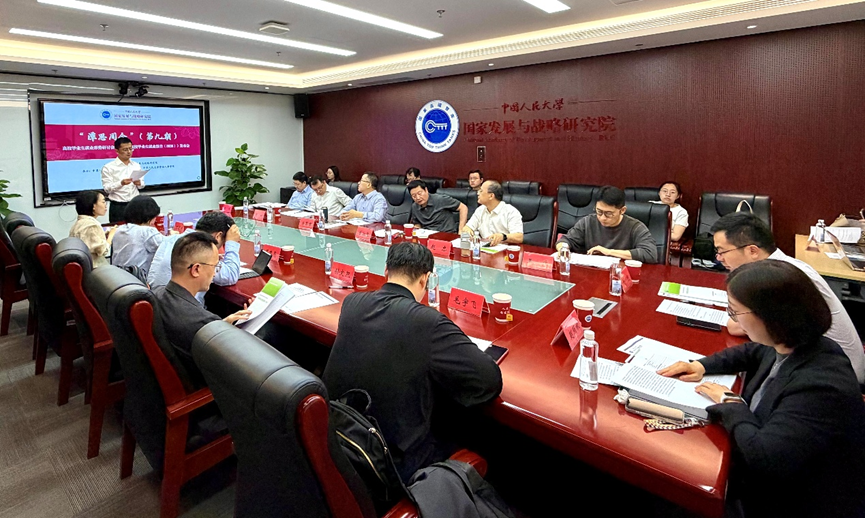
On May 20, 2026, the ninth TANSI Weekly Forum, titled “Seminar on the Employment Situation of University Graduates and Release of Report on the Employment of Chinese University Graduates (2026)”, was successfully held. The event was hosted by the National Academy of Development and Strategy, Renmin University of China, and co-organized by the Institute for Employment and Welfare Studies and the School of Labor and Human Resources, Renmin University of China.
The seminar specially invited ZENG Xiangquan, Professor at the School of Labor and Human Resources and Director of China Institute for Employment Research, and YUE Changjun, Professor at the Graduate School of Education and Director of the Institute of Economics of Education, Peking University, to deliver keynote speeches. WANG Fei, Associate Professor at the School of Labor and Human Resources and Deputy Director of the Institute for Employment and Welfare Studies, Renmin University of China, released the China University Graduate Employment Report (2026) on behalf of the research group. Experts participating in the panel discussion included LUO Chuliang, Dean and Professor of the School of Labor Economics, Capital University of Economics and Business; WU Binzhen, Tenured Associate Professor at the School of Economics and Management, Tsinghua University; MAO Yufei, Associate Professor of the School of Labor Economics, Capital University of Economics and Business; SUN Wenkai, Professor at the School of Economics, Renmin University of China; ZHAO Liqiu, Chair and Professor of the Department of Labor Economics, School of Labor and Human Resources, Renmin University of China; and LIU Kai, Professor at the School of Labor and Human Resources and Deputy Director of the Institute for Employment and Welfare Studies, Renmin University of China. DING Liting, Director of the Student Career and Entrepreneurship Guidance Center, CHEN Yao, Party Secretary of the School of Labor and Human Resources, and WANG Wei, Deputy Dean of the National Academy of Development and Strategy, Renmin University of China, attended the meeting. ZHAO Zhong, Dean and Professor of the School of Labor and Human Resources as well as Director of the Institute for Employment and Welfare Studies, delivered an opening address and made concluding comments. The event was presided over by ZOU Xianqiang, Associate Professor of the School of Labor and Human Resources and Deputy Director of the Institute for Employment and Welfare Studies, Renmin University of China.
In his opening address, ZHAO Zhong emphasized that research on university students’ employment bears on the nation’s future and the aspirations of the younger generation, exerting far-reaching influences on policy, society and families. He expressed sincere gratitude to all participating experts and leaders for their support, and looked forward to further deepening cooperation, building consensus across all parties, and jointly advancing the high-quality development of university graduates’ employment work.
Professor ZENG Xiangquan delivered a keynote speech titled “Challenges and Countermeasures for High-Quality and Full Employment: From the Perspectives of Scale, Quality and Structure”. He pointed out that employment efforts have shifted from a sole focus on employment volume to pursuing high-quality and full employment, which requires equal attention to three core dimensions: scale, quality and structure. In terms of scale, employment is essentially a macroeconomic issue closely linked to policies concerning investment, consumption, import and export, and public finance. He suggested coordinated efforts on the demand side, supply side and institutional front, prioritizing the development of service industries with strong employment elasticity, promoting employment-friendly upgrading of the manufacturing sector, and scaling up support for small and medium-sized enterprises. Regarding employment quality, he noted that phenomena such as disguised unemployment and concealed employment merit close attention, and proposed adopting internationally recognized indicators including the underemployment rate. For working hours, he advocated optimizing the minimum wage system based on hourly rates for full-time jobs. In terms of social security, institutional innovation is urgently needed to define labor relations and protect workers’ rights and interests in the platform economy. From a structural perspective, the major contradiction in current employment lies in the structural mismatch between labor supply and demand, especially the prominent deficiencies in managerial competence and interdisciplinary cognitive capabilities. He recommended increasing investment in human capital and improving its efficiency, transforming the education system from knowledge imparting to competency cultivation, and focusing on fostering students’ soft skills including achievement motivation, communication skills, resilience and management capabilities.
Professor YUE Changjun delivered a keynote speech entitled “Analysis on the Employment Characteristics and Trends of University Graduates”. Based on long-term tracking survey data, he systematically outlined the core features of university graduates’ employment. In terms of employment destinations and income, most graduates are employed by the private sector, while there is a notable gap between actual earnings and salary expectations. Academic credentials, university types and family background all exert significant impacts on graduates’ career choices and pay levels. When it comes to employment satisfaction and competency development, professional interest stands out as the most influential factor for job satisfaction, highlighting the central role of psychological factors in career development. Meanwhile, a mismatch exists between university education and market demands. Students generally report inadequate access to internships, interdisciplinary learning opportunities and career guidance services. Regarding the application of artificial intelligence in job hunting, AI-assisted tools can effectively boost the employment rate. He suggested that universities improve the transparency of employment information to help students establish reasonable career expectations.
Associate Professor WANG Fei officially released the China University Graduate Employment Report (2026) on behalf of the research group of the Institute for Employment and Welfare Studies. Based on online survey data collected in collaboration with Tencent, the report systematically illustrates the latest employment status of university graduates from multiple dimensions, including employment quality and preferences, job-hunting processes and outcomes, structural disparities among different groups, and the impact of artificial intelligence on employment. It focuses on analyzing graduates’ income levels, job satisfaction and labor contract signing status, as well as the expectation gaps and career preferences of new graduates during job hunting. The report also explores how factors such as gender, family background, university tier, academic discipline and internship experience affect employment quality, and suggests that internship experience plays a vital role in raising employment rates and job satisfaction. In terms of AI impacts, the report examines the prevalence of graduates using AI tools for resume polishing and interview preparation, and how their understanding of AI shapes career choices. Drawing on these findings, the report puts forward policy recommendations, including expanding market-oriented employment channels, improving the transparency of employment information, delivering targeted employment assistance, and strengthening students’ AI literacy training.
During the expert panel discussion, participating scholars held in-depth exchanges on topics including the employment situation, data research methods and policy proposals.
Professor YUE Changjun first spoke highly of the data in the report, noting that its findings are largely consistent with his own survey results, especially in key indicators such as salary levels and types of employers. He suggested that future surveys could track graduates six months after graduation and keep an eye on the employment status of graduates from different tiers of universities to present a more comprehensive picture. He also voiced his willingness to continue supporting cross-institutional cooperation.
Professor LUO Chuliang stressed that internships serve as an important means to bridge the gap between university education and market demands. However, employment is a systematic project and should not be simply attributed to the education sector. Joint efforts from both the demand side and the supply side are therefore required. He called for more research on the demand side and greater attention to the impact of changes in the macro environment on employment, and proposed conducting surveys among enterprises to build a full view of labor supply and demand.
Associate Professor WU Binzhen pointed out that it is urgent to conduct follow-up surveys on student development amid the ongoing transition. She held that real-time data is more valuable than retrospective information and emphasized the significance of first-hand data in the AI era. She noticed a disconnect between the apparent popularity and actual application of AI tools, and shared findings from the pilot survey regarding how AI courses and internship experiences affect employment outcomes. She also mentioned that private enterprises are the main employers for graduates, yet a considerable share of students prefer state-owned enterprises. Such supply-demand mismatch is partly attributable to inadequate career guidance from universities.
Professor ZHAO Liqiu analyzed the shifting trends in graduates’ employment preferences in recent years. She noted that the overall demand for stable jobs is on the decline while the number of people taking flexible jobs keeps rising, and stressed that consistent employment support policies are crucial to achieving sound employment outcomes.
Associate Professor MAO Yufei argued that the employment challenges facing university graduates lie not only in overall labor demand but more importantly in structural imbalances. While positions in public sectors are limited, most graduates regard them as their top choice, leaving small and micro enterprises as their final option. He also observed that many students rely on AI to finish academic tasks, and suggested that the education system should step up efforts to cultivate students’ competency in using AI tools and reinforce guidance on academic norms.
Professor SUN Wenkai shared his insights from perspectives including employment stability, labor supply and demand, high-quality corporate development and overseas expansion. He drew attention to the risk of talent turnover reflected in employees’ intention to switch jobs, and analyzed how university enrollment expansion affects the signaling effect of academic credentials. He suggested shifting research focus to improving job quality, and pointed out that enterprises’ overseas expansion represents a potential growth market.
Professor LIU Kai introduced the institute’s upcoming survey on AI and employment, which will cover 300 enterprises and focus on the skill matching between university graduates and employers.
Party Secretary CHEN Yao noted that many existing policies still leave much room for improvement. Universities bear heavy responsibilities for graduate employment, and there exists a certain mismatch between policy objectives and students’ career preferences. He proposed clarifying talent training standards for career development courses and enhancing teachers’ career guidance capabilities. He also recommended leveraging the Ministry of Education’s curriculum standard revision to integrate research findings into teaching practice.
Dean ZHAO Zhong delivered the closing remarks. He stated that the seminar brought together leading experts in labor economics, education and career guidance, yielding fruitful outcomes. Participants reached broad consensus on employment scale, quality and structure, and put forward numerous topics worthy of further exploration regarding research methodologies and policy approaches. He emphasized that establishing a long-term mechanism for high-quality employment of university graduates requires joint efforts: expanding job creation on the demand side and advancing educational reform on the supply side. He called on all research teams to strengthen communication and collaboration, and set up a regular expert exchange mechanism for in-depth discussions on a periodic basis. Lastly, he noted that the Institute for Employment and Welfare Studies at Renmin University of China will continue to leverage its strengths as a high-end think tank, providing solid academic support and scientific reference for policy-making to advance high-quality and full employment among university graduates nationwide.
This seminar has built a high-level platform for interdisciplinary and inter-institutional academic exchanges, effectively uniting consensus across all sectors on the employment situation of university graduates and fully presenting the core findings of the China University Graduate Employment Report (2026). The seminar proposes to establish a regular inter-institutional cooperation mechanism. Through data sharing and joint research, all parties will work together to promote higher-quality and fuller employment for university graduates.
Proofreaders: WANG Wei, ZHAO Zhong
Translator: ZHANG Yuqing
Web Editor: ZHANG Jingjing
Introduction to the Innovation Hub
The Institute for Employment and Welfare Studies is an innovation hub established under the auspices of Renmin University of China. It conducts a wide range of research including basic theoretical innovation, major policy studies and applied practical analysis on employment and people's livelihood issues from multidisciplinary and multi-dimensional perspectives. Taking the national strategies of prioritizing employment, developing a talent-driven nation, pursuing high-quality development and advancing common prosperity in the new era as opportunities, the institute strives to address major transformations and key challenges facing human society, such as the new round of technological revolution, the transition from industrial to post-industrial society, changes in production factors and organizational forms, and shifts in population structure. Drawing on Renmin University of China’s strengths in social sciences, the institute is rooted in disciplines including economics, public administration and business administration. It fully integrates theories and methodologies across different fields to boost interdisciplinary integration, and learns from practical experience both at home and abroad. Centering on workers, focusing on employment and targeting people’s well-being, it carries out work covering theoretical innovation, policy research, practical analysis and talent development. Moving forward, the institute will keep producing high-quality research outcomes that serve national development and public interests. It will build an all-round integrated platform, sound achievement system and distinctive brand, so as to comprehensively enhance its contribution, influence and visibility.
About TANSI Weekly Forum
The “TANSI Weekly Forum” is a high-level interdisciplinary discussion platform established by the National Academy of Development and Strategy at Renmin University of China. Focusing on frontier academic and policy issues, the forum brings together the intellectual strengths of the university’s innovation hubs as well as leading scholars and policy experts across sectors. Through in-depth exchanges and discussions, the forum aims to produce high-quality think tank achievements characterized by strategic vision, contemporary relevance, and intellectual depth. It serves as an important platform for advancing knowledge innovation, theoretical innovation, and policy innovation, while promoting the mutually reinforcing relationships between academic disciplines, policy consultation, and think tank development.