


 Research Update
23
January
On January 14, 2026, the 23rd Sino-U.S. Political and Economic Forum, hosted by the National Academy of Development and Strategy (NADS) at Renmin University of China, was livestreamed online. The forum was moderated by ZHAO Yong, Research Fellow at NADS and Professor at the School of Economics, Renmin University of China.
The report, “The Evolution of the National Security Legal System: Four Faces of the U.S. Government (constitutional government, national security state, emergency state, and hegemonic government)”, was delivered by ZHANG Yan on behalf of the research team, Professor at the Law School of Renmin University of China and Research Fellow at NADS. Distinguished experts and scholars in related fields, including CUI Fan, HUANG Yanghua, JIANG Zhaoxin, LI Honglei, and LIU Yawei, jointly provide in-depth analysis and discussion.
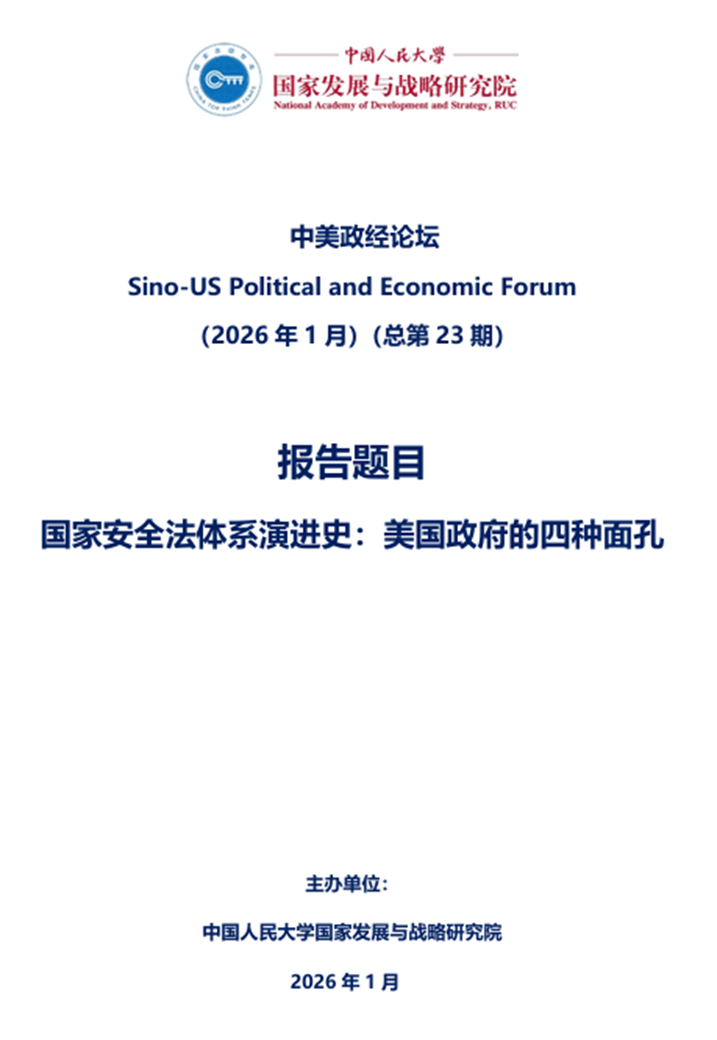
In the first session, Professor ZHANG Yan presented the report titled “The Evolution of the National Security Legal System: Four Faces of the U.S. Government (constitutional government, national security state, emergency state, and hegemonic government)”.
The report focused on the following key themes:
1. The Initial Formation of the National Security Legal System during the Period of Nation-State Building (1789-1945)
2. The National Security Legal System during the U.S.-Soviet Cold War (1947-1991)
3. The U.S. National Security Legal System in the Era of Unipolar Dominance (1990s-2001)
4. The Reshaping and Expansion of U.S. National Security Law Centered on Counterterrorism (2001-2016)
5. National Security Law Centered on “Major Country Competition” (2017-Present)
6. Conclusion: An Overall Assessment of the U.S. National Security Legal System—An Integrated Portrait of Its Four Faces
7. Summary
The U.S. national security legal system has evolved over several centuries, developing a three-tiered governance structure. First, it manifests three modes of governance. The constitutional government operates within the constitutional framework, emphasizing legal constraints and the protection of civil rights, and symbolizes the system’s commitment to constitutional legitimacy. The national security government, grounded in the National Security Act of 1947, has constructed a vast security bureaucracy (such as the Department of Defense and the CIA), institutionalizing a normalized logic of “security first.” The emergency state government relies on presidential emergency powers, which may temporarily override constitutional constraints and exclude judicial review, functioning as a supra-legal instrument for crisis response.
A fourth mode has emerged in the era of competition between major countries : through a “whole-of-government” approach, the United States has implemented technological and economic containment against China, with the 2020 version of the “emergency state government” becoming a long-term legal instrument targeting China. The legal system and annual national security strategy reports complement each other, jointly shaping a flexible mechanism for the maintenance of U.S. hegemony.
In the second session of the forum, the experts engaged in in-depth discussions on relevant topics and the content of the report.
CUI Fan, Professor at the School of International Trade and Economics, University of International Business and Economics, and Chief Expert of the China Society for World Trade Organization Studies, noted that the U.S. national security legal system exhibits a dual logic of “inconsistency between appearance and substance”.
HUANG Yanghua, Professor and Vice Dean of the School of Peace and Development at Renmin University of China, argued that the “four faces” of the U.S. national security system—constitutional government, national security state, emergency state, and hegemonic government—reveal its deep-seated orientation toward national interests, as well as its instrumentalist and pragmatist core, rather than the superficial myth of liberal constitutionalism.
JIANG Zhaoxin, Professor at the Law School of Shandong University and Honorary Research Fellow at The Chinese University of Hong Kong, observed that the U.S. national security legal system is a broad and continuously evolving complex system. Its defining feature lies in the deliberate avoidance of a clear definition of “national security”, which enables the perpetual expansion of the security concept and facilitates the growth of executive power.
LI Honglei, Research Fellow and Deputy Party Secretary of the Joint Party Committee of the Institute of Law and the Institute of International Law at the Chinese Academy of Social Sciences, remarked that the report’s central arguments possess both strong historical penetration and significant explanatory power for contemporary realities.
LIU Yawei, Senior Advisor on China Affairs at the Carter Center, emphasized the importance of research on the evolution of the U.S. national security legal system. Such research, he noted, offers a new framework for understanding U.S. domestic and foreign behavior, while also prompting reflection on the transformation of China’s own security concept, from an inward-looking, revolutionary focus to an approach that integrates both domestic and external considerations.
Proofreaders: ZHAO Yong, ZHANG Yan
Translator: ZHANG Yuqing
Web Editor: ZHANG Jingjing