 Research Reports
16
March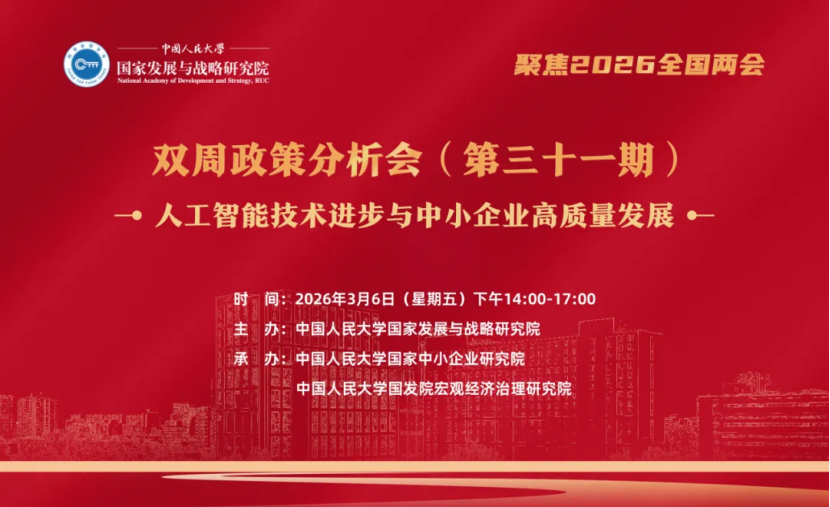
Against the backdrop of continuous breakthroughs in artificial intelligence (AI) technology and the rising demand for transformation and upgrading among small and medium-sized enterprises (SMEs), promoting AI-enabled high-quality development of SMEs has become an important topic. At present, with the ongoing improvement of open-source models, platform tools, intelligent computing power, and public service systems, the threshold for SMEs to adopt AI has been lowered. Initial application scenarios have emerged in fields such as e-commerce, marketing, customer service, research and development, as well as policy services, fiscal and tax services, and technology commercialization. The practical foundation for AI empowering SMEs is gradually being solidified.
Overall, however, current applications still exhibit certain characteristics: the service sector is advancing faster than manufacturing, consumer-facing applications outpace production-end applications, and general-purpose tools are adopted more quickly than vertical-specific solutions. Deep applications in complex industrial scenarios remain relatively limited. The main constraints on SME adoption of AI include high cost inputs, unclear identification of application scenarios, insufficient alignment between technological supply and enterprise demand, underdeveloped data infrastructure, standards, and security governance systems, and gaps between model capabilities and industrial requirements for precision, stability, and reliability. Additionally, the spillover effects of AI on employment structures, enterprise organization, and social governance are increasingly evident.
Moving forward, it is recommended to focus on the actual needs of SMEs and coordinate efforts in technology adaptation, scenario development, and service model innovation. Further improvements should be made in computing power supply, industry-specific models, data governance, standards and regulations, and public service systems. This will help transform AI applications from being “trial-based” to “replicable, scalable, and sustainable,” better supporting SME innovation, transformation and upgrading, and employment stabilization and expansion.
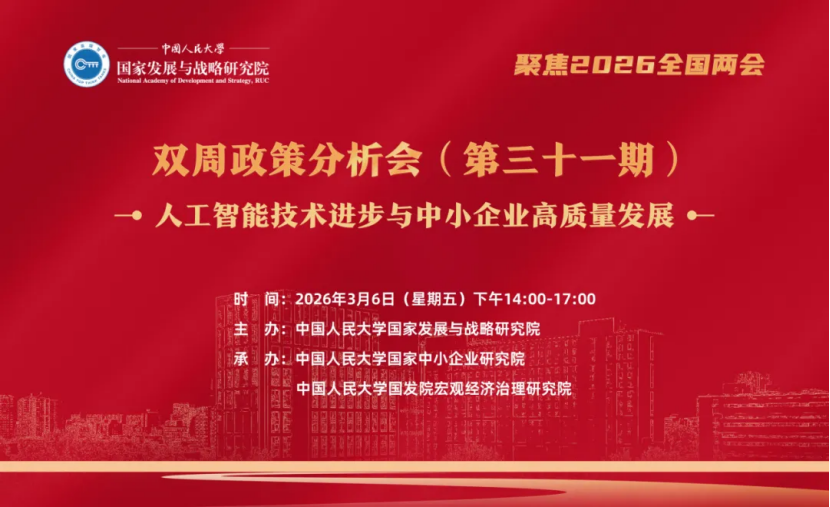
(The above views are compiled from the statements made by participants at the 31th Biweekly Policy Analysis Meeting. It is intended solely for academic exchange and does not represent the views of the National Academy of Development and Strategy, Renmin University of China.)
Proofreaders: SUN Wenkai, ZOU Jingxian
Translator: ZHANG Yuqing
Web Editor: ZHANG Jingjing, ZHANG Yuqing